

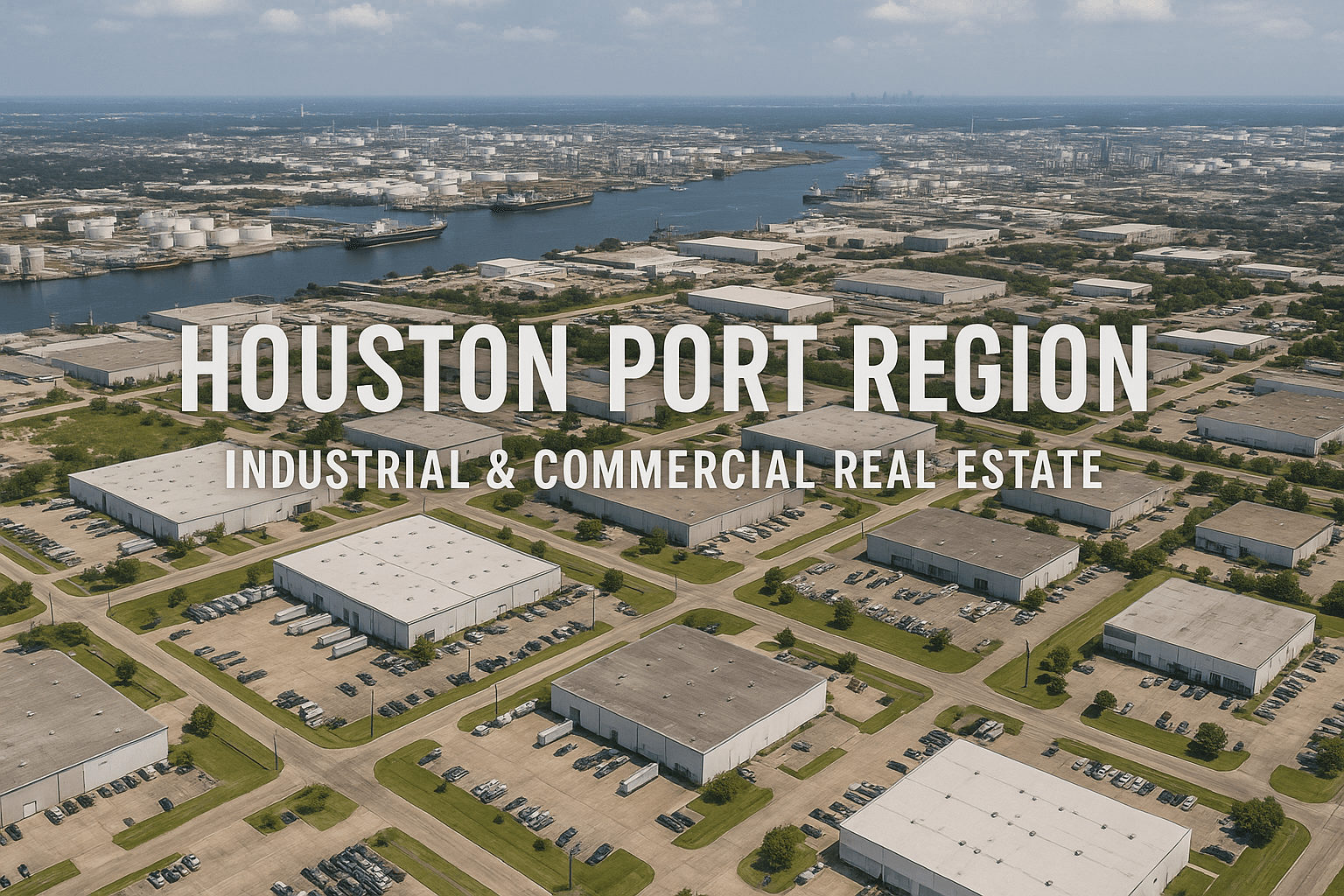
Houston Port Region Industrial Tenants: 2025 Market Update
The Houston Port Region continues to cement its status as one of North America's most dynamic industrial real estate markets, driven by unprecedented infrastructure investments, robust tenant demand, and its strategic position as the nation's busiest port complex by tonnage. As we move through 2025, businesses and investors are capitalizing on the region's unique advantages—from deepwater channel expansions to sustainable facility development—creating opportunities across petrochemical, logistics, manufacturing, and distribution sectors.
This market update examines the forces reshaping Houston's port-adjacent industrial landscape, profiles the diverse tenant base fueling demand, and explores emerging trends that position this region for continued growth in an evolving global trade environment.
Strategic Location and Infrastructure Advantages
The Houston Port Region occupies a commanding strategic position, providing direct access to the Gulf of Mexico and serving as the primary gateway for U.S. trade with Latin America, Europe, and Asia. This geographic advantage has transformed the region into a magnet for businesses seeking efficient supply chain solutions and expansive market reach across both domestic and international corridors.
Recent infrastructure upgrades have significantly enhanced the port's competitive position. The Port of Houston Authority completed the $1 billion Bayport Container Terminal expansion and advanced the Houston Ship Channel widening and deepening project—Project 11—which enables the facility to accommodate Neo-Panamax vessels carrying up to 14,000 twenty-foot equivalent units. These improvements have directly increased cargo handling capacity by approximately 35% since 2020, attracting liner services and logistics operators that require state-of-the-art terminal capabilities.
The infrastructure investments extend beyond the waterfront. Highway improvements along the I-610 loop, expansions to State Highway 146, and ongoing freight rail capacity enhancements by Union Pacific and BNSF have reduced drayage times and improved first-mile/last-mile connectivity for warehouses and distribution centers throughout the region. This multimodal accessibility remains a decisive factor for companies evaluating Houston industrial real estate against competing Gulf Coast markets.
Diverse Industrial Tenant Base Driving Market Resilience
One of the Houston Port Region's defining characteristics is its exceptionally diverse tenant composition, spanning petrochemicals, energy services, advanced manufacturing, third-party logistics (3PL), cold storage, and e-commerce fulfillment. This industrial diversity insulates the market from sector-specific downturns and creates consistent demand across multiple property types.
Petrochemical and Energy Sector Tenants: The Houston Ship Channel remains the world's largest petrochemical complex, home to refineries, chemical plants, and specialty manufacturers requiring proximate warehouse and distribution space for raw materials and finished goods. Major tenants include ExxonMobil, LyondellBasell, Chevron Phillips Chemical, and INEOS, many of which have expanded their logistics footprints to support just-in-time delivery models and tightening environmental regulations requiring enclosed storage.
Logistics and Distribution Operators: National and international 3PL providers—including DHL Supply Chain, Kuehne + Nagel, and C.H. Robinson—have established significant Houston port logistics operations to serve import/export clients. The region's proximity to major consumer markets (Houston metro area, Dallas-Fort Worth via I-45, San Antonio via I-10) makes it an ideal distribution node for retailers, consumer goods manufacturers, and automotive parts suppliers.
Manufacturing and Assembly: The port region has attracted manufacturers seeking to nearshore production or establish U.S. assembly operations with easy access to imported components. Steel processors, plastic fabricators, automotive parts manufacturers, and industrial equipment assemblers occupy millions of square feet of industrial space within a 20-mile radius of the port terminals.
Cold Storage and Food Distribution: Growing import volumes of perishable goods from Latin America and increasing demand for temperature-controlled storage have driven cold storage development. Lineage Logistics, Americold, and regional operators have added capacity to serve food importers, grocery distributors, and restaurant supply chains.
This tenant diversity creates layered demand cycles. When energy sector activity softens, logistics and e-commerce absorption often compensates, maintaining relatively stable occupancy rates and rental growth across the broader industrial market.
Industrial Real Estate Demand and Market Fundamentals
Demand for industrial real estate in the Houston Port Region has remained exceptionally strong through the first quarter of 2025, supported by nearshoring trends, inventory restocking following pandemic-era disruptions, and continued growth in containerized imports through Port Houston facilities.
Absorption and Vacancy Trends: The port-adjacent industrial submarket has recorded positive net absorption for twelve consecutive quarters. Vacancy rates in Class A warehouse and distribution space within the 610 Loop and East Houston industrial corridors currently range from 3.8% to 5.2%—well below the national industrial average of approximately 6.5%. Institutional-quality facilities exceeding 250,000 square feet with 36-foot clear heights and ESFR sprinkler systems command particular premium, with asking rents reaching $9.50 to $11.00 per square foot triple-net in prime locations.
Leasing Velocity: Average time-on-market for quality industrial properties has compressed to 45-60 days for spaces under 100,000 square feet and 90-120 days for big-box facilities, compared to 120-180 days in more balanced market conditions. This acceleration reflects both limited available inventory and heightened competition among tenants seeking Houston Ship Channel industrial space.
Build-to-Suit and Pre-Leasing Activity: Developers report that approximately 65-70% of new speculative projects exceeding 500,000 square feet are securing anchor tenants during construction—a marked increase from the 40-50% pre-lease ratio typical in previous cycles. This trend indicates strong tenant confidence and willingness to commit to long-term occupancy in preferred locations before alternatives reach the market.
Investment activity has mirrored operational demand. Cap rates for stabilized, credit-tenant industrial assets near the port have compressed to the 5.25%-6.00% range for institutional buyers, reflecting strong conviction in long-term cash flow stability and rent growth potential in this strategically irreplaceable location.
Emerging Trends and Market Opportunities
Several transformative trends are reshaping tenant requirements and development strategies across the Houston Port Region, creating differentiated opportunities for businesses and real estate investors who can anticipate and respond to evolving operational needs.
Sustainability and ESG-Driven Facility Requirements
Corporate sustainability commitments are driving unprecedented demand for eco-friendly industrial facilities equipped with energy-efficient systems, LED lighting, rooftop solar arrays, electric vehicle charging infrastructure, and advanced building management systems. Fortune 500 logistics tenants increasingly require LEED certification or equivalent green building standards as prerequisites for site selection.
The Port of Houston Authority has accelerated its own sustainability initiatives, including shore power installations that allow docked vessels to shut down auxiliary engines and clean truck programs that incentivize low-emission drayage fleets. These port-level programs complement tenant-driven sustainability requirements, creating alignment between facility operators and their supply chain partners.
Automation and Technology Integration
Warehouses and distribution centers are incorporating higher levels of automation—from automated storage and retrieval systems (AS/RS) to autonomous mobile robots (AMRs) and sophisticated warehouse management systems (WMS) integrated with port terminal operating systems. These technological requirements translate into specific building features: reinforced floor slabs to support racking systems, enhanced electrical capacity (2000+ amps), extensive fiber-optic connectivity, and column spacing optimized for automated equipment paths.
Developers who design facilities with automation-ready infrastructure are achieving lease-up premiums of 8-12% compared to conventional warehouse construction, as tenants increasingly prioritize operational efficiency and labor productivity in tight labor markets.
Nearshoring and Inventory Repositioning
The ongoing shift toward nearshoring manufacturing and sourcing from Mexico, Central America, and South America positions Houston's port facilities advantageously. Companies reducing reliance on trans-Pacific supply chains are establishing distribution nodes near Gulf Coast ports to receive Latin American imports and serve U.S. markets more efficiently.
This trend has accelerated demand for cross-dock facilities, transload operations, and facilities capable of handling both containerized and bulk cargo—creating opportunities for specialized industrial developers and landlords offering flexible space configurations.
Future Outlook and Investment Considerations
The Houston Port Region's trajectory remains decidedly positive as we progress through 2025 and look toward the remainder of the decade. Multiple convergent factors support continued strength in industrial real estate fundamentals and investment performance.
Infrastructure Investment Pipeline: Beyond completed projects, the Port of Houston Authority has outlined a ten-year capital improvement program exceeding $2 billion, focusing on additional terminal capacity, channel maintenance, intermodal connectivity, and sustainability infrastructure. These public investments will continue attracting private capital to adjacent industrial development.

Population and Economic Growth: The Houston metropolitan area continues adding approximately 100,000 residents annually, sustaining consumption-driven demand for warehousing and distribution capacity. The region's diversified economy—energy, healthcare, aerospace, technology—provides resilience against sector-specific volatility that affects single-industry markets.
Pro-Business Regulatory Environment: Texas maintains a business-friendly regulatory framework with no state income tax, relatively streamlined permitting processes, and competitive utility costs. Combined with Houston's lower cost structure compared to coastal gateway markets, these factors continue attracting corporate relocations and expansions that generate industrial real estate demand.
Supply Discipline: Unlike some Sun Belt markets experiencing speculative overbuilding, Houston port-area industrial development has remained relatively disciplined, with new supply closely tracking absorption trends. This supply-demand balance supports sustained rent growth and occupancy stability.
For businesses evaluating expansion or relocation opportunities, the Houston Port Region offers a compelling value proposition: world-class logistics infrastructure, diverse tenant ecosystem, competitive operating costs, and proven long-term growth fundamentals. Companies in logistics, manufacturing, distribution, and energy-adjacent sectors should consider establishing or expanding presence in this market before tightening availability further constrains options.
Investors seeking industrial real estate exposure will find the Houston port corridor offering attractive risk-adjusted returns supported by structural demand drivers, limited new supply in prime locations, and replacement cost advantages compared to redeveloping constrained infill sites. Whether pursuing core stabilized assets or value-add repositioning opportunities, this market provides depth and liquidity across the risk spectrum.
At BulldogBroker CRE, we maintain deep expertise in Houston's industrial market, representing both tenants seeking optimal locations and landlords maximizing asset value. Our Houston market intelligence and transaction experience position us to guide clients through this dynamic and competitive landscape.
For companies and investors ready to capitalize on the Houston Port Region's continued growth, the opportunity window remains open—but narrowing as demand intensifies and premier sites become increasingly scarce. Contact our team to explore how this market's unique advantages align with your strategic objectives.

Licensed commercial real estate broker serving New Jersey and Houston, TX. 25+ years of cross-industry experience across aerospace, oil & gas, technology, and manufacturing — applied to landlord representation, tenant rep, investment sales, and CRE consulting.
Continue reading
All market updates →
Houston Industrial Real Estate Market Update Q2 2026: Vacancy Rises to 7.3%
Houston's industrial market is still solid and performing but has hit a vacancy rate it hasn't seen since 2010. What you should know and areas to look for when investing.
Newark Industrial Snapshot: Where Port-Adjacent Warehouse Vacancy & Cap Rates Sat in Q1 2024
Geo-specific deep dive capturing hyper-local search intent for Newark's port-driven industrial market
How we can help
Talk to a licensed broker about your specific transaction — Houston + New Jersey.