

Class A vs Class B Warehouses in Katy-Brookshire: Which 3PL Property Type Delivers Better ROI?
The Katy-Brookshire industrial corridor has become one of Houston's most competitive markets for third-party logistics providers seeking warehouse space. With proximity to I-10, the Port of Houston, and major distribution arteries, the area offers compelling logistics advantages. But not all warehouse space is created equal, and the choice between Class A and Class B properties can significantly impact your operational efficiency and bottom line.
Class A warehouses typically feature clear heights above 32 feet, modern ESFR sprinkler systems, ample trailer parking, and energy-efficient construction. Class B properties, while older or with fewer high-end features, often provide substantial cost savings and sufficient functionality for many 3PL operations. The decision isn't simply about budget—it's about aligning building specifications with your clients' requirements, growth trajectory, and service model.
In this analysis, we'll break down the concrete differences between these property classes in the Katy-Brookshire market, compare total occupancy costs, and help you determine which warehouse type makes the most sense for your 3PL business.
What Defines Class A vs. Class B Warehouse Space
Industrial real estate classifications aren't standardized across the industry, but market participants generally agree on the core distinctions between Class A and Class B warehouse properties. Understanding these differences is essential for making informed leasing decisions in the competitive Katy-Brookshire corridor.
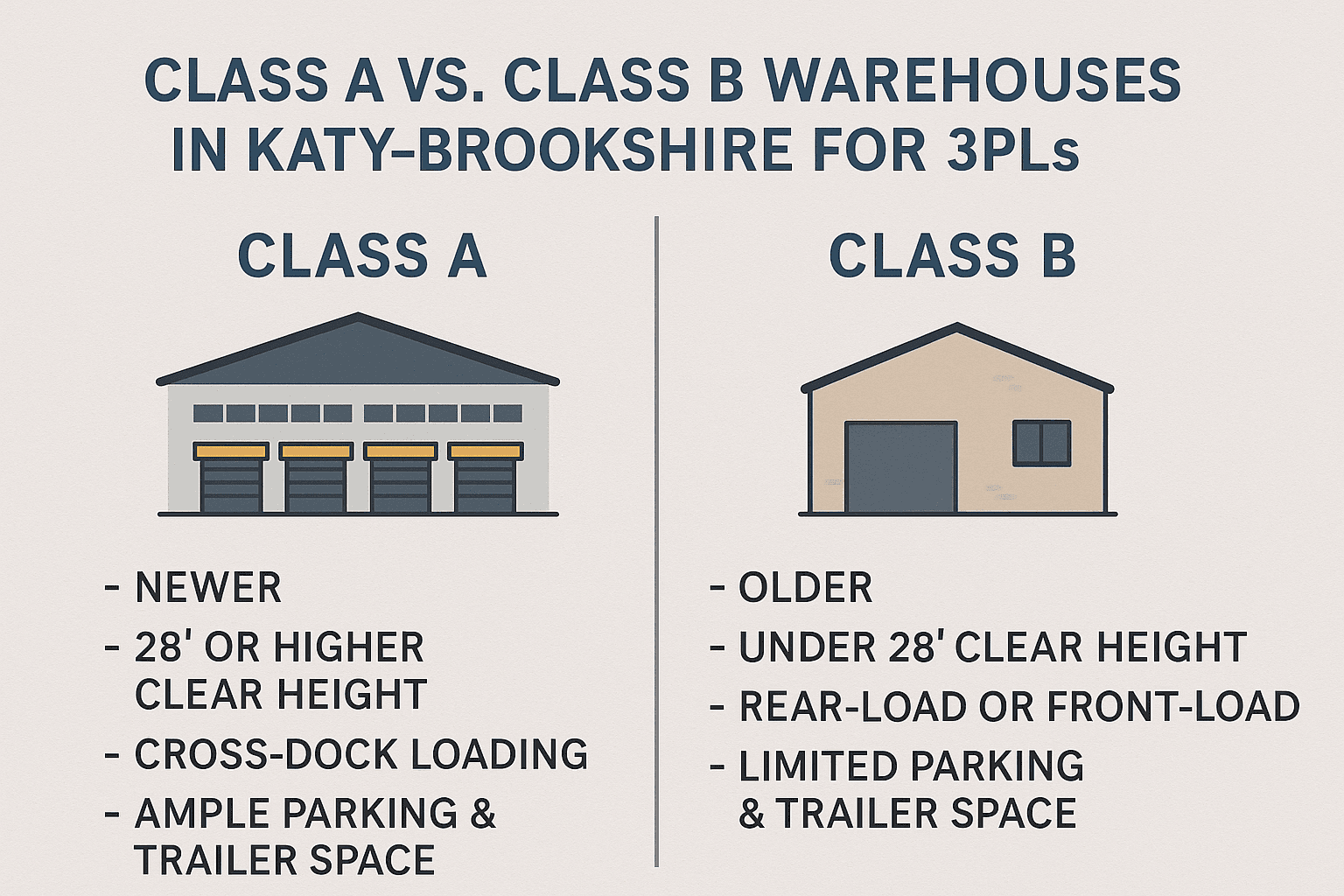
Class A warehouse facilities represent the newest and most technologically advanced properties in the market. These buildings typically feature clear heights of 32 to 40 feet, allowing for maximum vertical storage density with modern racking systems. Construction is generally post-2010, with energy-efficient LED lighting, white TPO roofing that reduces cooling costs, and ESFR (Early Suppression Fast Response) sprinkler systems that meet current fire codes without requiring in-rack sprinklers.
The loading infrastructure in Class A warehouses in Katy TX typically includes one dock door per 8,000-10,000 square feet, with dock-high doors equipped with levelers and seals. Trailer parking ratios often exceed 1:1 with the dock door count, and the concrete truck courts are designed for modern 53-foot trailers with turning radii that accommodate today's logistics fleet.
Class B industrial property in Brookshire and Katy generally includes buildings constructed between 1985 and 2010, with clear heights ranging from 24 to 30 feet. While these facilities may have older HVAC systems, T8 fluorescent lighting instead of LED, and less extensive trailer parking, they remain fully functional for many 3PL operations—particularly those handling palletized goods, e-commerce fulfillment with moderate SKU counts, or regional distribution that doesn't require maximum cubic storage.
The key distinction isn't just age—it's alignment with modern supply chain requirements. A well-maintained Class B warehouse with strategic updates can outperform a poorly located Class A facility for specific 3PL business models.
Why Katy-Brookshire Appeals to 3PL Operators
The Katy-Brookshire industrial corridor's appeal to third-party logistics providers stems from a combination of strategic location, infrastructure investment, and market dynamics that create operational advantages difficult to replicate elsewhere in the Houston metro.
Interstate 10 forms the backbone of this appeal. The corridor provides direct access to Houston's inner loop (15-20 miles east), the Port of Houston (35-40 miles), and critical westbound lanes serving San Antonio, Austin, and transcontinental freight routes. For 3PL operators managing regional distribution or serving multiple Texas metros, this central positioning reduces deadhead miles and improves driver utilization.
Beyond highway access, the Katy-Brookshire area offers labor pool advantages. The population of Katy and surrounding Fort Bend and Waller counties has grown substantially, providing warehouse workforce availability that's become scarce in Houston's inner industrial markets. Proximity to residential areas west of Highway 6 means shorter commutes for warehouse associates—a meaningful advantage in today's competitive labor market where retention directly impacts operational costs.
Utility infrastructure has kept pace with industrial growth. Both Katy and Brookshire maintain robust electrical capacity, with many newer warehouse developments offering 2000-3000 amp service suitable for automation equipment, extensive dock door operations, and climate-controlled staging areas. Natural gas availability supports operations requiring temperature control or specialized processing.
From a real estate perspective, the market offers inventory depth across both Class A and Class B segments. Unlike some Houston submarkets where options are limited to one building class, Katy-Brookshire provides genuine choice—allowing 3PL operators to select facilities that align with client requirements rather than settling for whatever's available.
Class A Warehouse Features: Modern Infrastructure for High-Volume 3PLs
Modern warehouse space in Katy TX designed to Class A specifications delivers infrastructure advantages that translate directly to operational capacity and efficiency for high-volume 3PL operations.
Clear height specifications in Class A facilities typically range from 32 to 36 feet, with some newer developments reaching 40 feet. This vertical capacity allows rack configurations up to 30 feet tall, effectively doubling or tripling the storage density compared to 24-foot clear height buildings. For 3PLs managing high SKU counts or seasonal inventory surges, this cubic capacity can mean the difference between expanding to a second facility or handling growth within existing walls.
The structural loading capacity in newer construction typically supports floor loads of 125 pounds per square foot or higher, accommodating modern very narrow aisle (VNA) racking systems and the concentrated loads they create. Column spacing in Class A warehouses in the I-10 corridor generally follows 50' x 50' or 55' x 50' grids, minimizing obstructions within the racking footprint and allowing flexible layout design as client needs change.
Loading dock infrastructure represents another meaningful difference. Class A properties typically provide one dock door per 8,000-10,000 square feet of building area, compared to 10,000-12,000 square feet in older Class B facilities. For a 100,000-square-foot operation, this translates to 10-12 doors versus 8-10—a difference that can create loading bottlenecks during peak shipping windows. Dock equipment in newer buildings includes hydraulic levelers, weather seals, and LED dock lights as standard, reducing maintenance costs and improving safety.
Energy efficiency in Class A warehouse facilities delivers measurable cost advantages. LED lighting throughout the building can reduce electrical consumption by 40-50% compared to T8 fluorescent or high-intensity discharge fixtures common in Class B buildings. White TPO roofing reflects solar heat, reducing cooling loads in Houston's climate by 15-25% according to industry studies. HVAC systems using high-efficiency rooftop units or, in some cases, evaporative cooling for warehouse areas further reduce utility costs.
Technology infrastructure in Class A developments often includes fiber optic connectivity, extensive electrical capacity for warehouse management systems and automation, and ceiling heights that accommodate mezzanine construction if needed for future expansion. While these features may not be utilized on day one, they provide expansion options that avoid costly retrofits later.
Lease rates for Class A warehouse space in Katy-Brookshire currently range from $6.50 to $8.50 per square foot NNN (triple net), depending on specific location, building age within the Class A category, and lease term. While this represents a premium over Class B rates, the operational efficiencies often justify the cost for 3PLs serving clients with demanding service level agreements or high-velocity inventory turnover.
Class B Warehouse Advantages: Cost Efficiency and Flexibility
Class B industrial property in the Katy-Brookshire corridor offers compelling advantages for 3PL operators whose business models prioritize cost control and operational flexibility over cutting-edge infrastructure.
The most immediate advantage is rental rate differential. Class B warehouse lease rates in the area typically range from $4.50 to $6.00 per square foot NNN—a 25-35% discount compared to Class A facilities. For a 100,000-square-foot operation, this translates to $200,000-$250,000 in annual base rent savings. For 3PL operators managing thin margins or serving price-sensitive clients, this cost advantage can be the difference between winning and losing contracts.
Beyond base rent, Class B properties often provide negotiation leverage that's harder to achieve in newer buildings. Landlords of older facilities may be more willing to offer concessions—extended free rent periods, more generous tenant improvement allowances, or flexible lease terms—particularly if the building has been vacant or if the owner is seeking a creditworthy tenant to stabilize cash flow. This negotiating position can yield total occupancy costs well below pro forma projections.
Functional adequacy is often underestimated when evaluating Class B warehouse space. A facility with 28-foot clear heights, dock-high loading, adequate parking, and 125-amp electrical service can handle a wide range of 3PL operations: e-commerce fulfillment with moderate SKU counts, regional distribution, contract packaging, light assembly, and cross-dock operations. Unless your operation requires specific Class A features—extreme clear height for high-density storage, extensive dock doors for high-velocity cross-dock, or automation requiring specialized infrastructure—Class B buildings deliver the necessary functionality at lower cost.
Many Class B warehouses in Brookshire and western Katy offer larger land parcels relative to building size, providing outdoor storage options for empty trailers, overflow inventory, or future expansion. This land availability is increasingly scarce in newer Class A developments, where site coverage ratios are maximized to optimize land value.
Flexibility for customization can be another advantage. Landlords of Class B properties may be more amenable to tenant-specific modifications—adding dock doors, upgrading electrical service, or reconfiguring office space—particularly in longer-term leases. While Class A landlords maintain strict standards to preserve building value for future re-leasing, Class B owners often recognize that property improvements enhance marketability and may share costs or amortize improvements into rental rates at favorable terms.
The utility cost structure in Class B facilities, while higher per square foot due to less efficient systems, is predictable and often acceptable for operations that don't require extensive climate control. For ambient storage or operations with minimal office space requirements, the efficiency gap between Class A and Class B buildings narrows considerably.
For 3PL operators in early growth stages, managing seasonal businesses, or operating on master service agreements with cancellation provisions, the lower financial commitment of Class B space reduces risk. If client contracts don't renew or volume projections don't materialize, the lower rent burden provides breathing room that higher-cost Class A facilities don't afford.
Tenant Improvement Allowances: How Building Class Affects Negotiation
Tenant improvement allowances represent one of the most significant but often misunderstood variables in warehouse lease economics, and the building class directly influences what's achievable through negotiation in the Katy-Brookshire market.
In Class A warehouse facilities, landlords typically offer TI allowances ranging from $5.00 to $15.00 per square foot for credit-worthy tenants signing 5-7 year leases. These allowances are structured to cover standard build-out items: office build-out at approximately $50-75 per square foot, warehouse painting, any required rack anchoring, and basic signage. Some landlords in competitive leasing situations may increase allowances for longer lease terms or larger spaces, but the trade-off is usually an escalated base rent or reduced free rent period.
The key advantage in Class A negotiations is that buildings require minimal capital investment beyond standard TI. The infrastructure—dock equipment, lighting, HVAC, electrical capacity—is already in place at modern standards. Your TI allowance focuses on cosmetic and tenant-specific items rather than correcting deficiencies or upgrading systems.
In Class B properties, TI allowances typically start lower—$3.00 to $8.00 per square foot—but the negotiation dynamic is fundamentally different. Because these buildings may require upgrades to compete functionally with newer space, landlords are often willing to fund improvements that enhance building value: LED lighting retrofits, dock door additions, electrical service upgrades, or HVAC replacements.
Savvy tenant representation in Class B negotiations involves identifying improvements that serve dual purposes—enhancing your operational efficiency while increasing the landlord's asset value. For example, adding two dock doors may cost $30,000-40,000, but increases the building's marketability to future tenants. Landlords may fund 50-100% of such improvements, either as TI allowance or as amortized rent adjustments, because the investment improves the property's re-leasing position.
The free rent period interacts with TI allowances in ways that vary by building class. Class A landlords typically offer 1-2 months of free rent for every year of lease term, calculated after TI construction is complete. Class B landlords may offer extended free rent—particularly in soft market conditions—to compensate for the time required to complete more extensive improvements. A well-negotiated Class B lease might include 4-6 months of free rent on a 5-year term, effectively offsetting the construction period and providing cash flow relief during the move-in phase.
Timing considerations also differ. Class A build-outs typically require 60-90 days for office construction and minor warehouse modifications. Class B improvements—particularly if they include electrical, HVAC, or structural work—may require 90-150 days, creating longer lead times between lease execution and operational occupancy. This timeline impacts your ability to serve clients and should be factored into decision-making.
For 3PL operators, the practical question is whether a higher TI allowance in Class A space (used primarily for office aesthetics) delivers more value than a lower allowance in Class B space (applied to functional improvements that reduce operating costs). The answer depends on your client mix: if you host client visits regularly or employ significant office staff, Class A office quality matters. If your operation is warehouse-focused with minimal client-facing space, directing capital toward dock doors or lighting upgrades in a Class B building may yield better ROI.
Operating Costs Compared: Utilities, Maintenance, and Insurance
Total occupancy cost analysis requires looking beyond base rent to the operating expenses that accumulate over a lease term. In NNN (triple net) lease structures common to Katy-Brookshire warehouse space, tenants pay their proportionate share of property taxes, insurance, and common area maintenance (CAM), plus their own utilities. The building class significantly impacts these costs.
Utility costs represent the most variable expense between Class A and Class B warehouses. Electricity consumption in Class B facilities with T8 or T5 fluorescent lighting typically runs 15-25% higher than LED-equipped Class A buildings. For a 100,000-square-foot warehouse operating two shifts, this can translate to $15,000-$25,000 annually in additional electrical costs. HVAC efficiency follows similar patterns: a Class B building with 15-20 year old rooftop units may consume 20-30% more energy for climate control than a Class A facility with high-efficiency equipment and superior insulation values.
However, these differentials are load-dependent. A 3PL operation using warehouse space primarily for ambient storage, with minimal office area and no specialized climate requirements, may see utility costs converge between building classes. Conversely, operations requiring extensive office space, cooled staging areas, or temperature-sensitive inventory storage will experience the full efficiency gap.
Natural gas costs (where applicable for heating) tend to be relatively comparable between building classes in Houston's mild winter climate, though newer buildings with better envelope performance require less heating runtime. Water and sewer costs are generally negligible for warehouse operations unless the facility includes significant restroom facilities, break rooms, or specialized processes.
Maintenance and repair costs favor Class A warehouses substantially. Newer buildings with warranties on roof systems, HVAC equipment, and building systems shift risk to manufacturers and contractors during the initial lease term. Routine maintenance—HVAC filter changes, lighting replacements, parking lot sweeping—costs roughly the same across building classes, but major repairs are far less likely in Class A facilities.
Class B buildings, by contrast, may require roof repairs or replacement, HVAC unit replacements, dock door repairs, or electrical system work during a typical 5-7 year lease term. While NNN lease structures often place these costs on landlords (depending on lease language), the reality is that extended downtime for major repairs can disrupt operations and impact client service—a cost that doesn't appear on financial statements but affects business viability.
The CAM (common area maintenance) expense in Class A properties typically runs $0.50-$1.00 per square foot annually, covering landscaping, parking lot maintenance, property management, and shared utilities. Class B properties may have similar or slightly higher CAM costs, particularly if deferred maintenance creates catch-up needs or if the property has older landscaping requiring more intensive care.
Property insurance costs generally favor Class A facilities, as insurance carriers price risk based on building systems, fire protection, and loss history. A Class A warehouse with ESFR sprinkler systems, modern electrical, and superior construction may see insurance rates 10-20% lower than comparable Class B space with older sprinkler systems and higher perceived risk profiles. For large users, this differential can amount to several thousand dollars annually.
Property tax burden reflects assessed value, which correlates to building class. Class A facilities carry higher assessments and therefore higher tax obligations per square foot. In Fort Bend County and Waller County (covering most of the Katy-Brookshire corridor), effective tax rates on commercial property typically range from 2.5-3.0% of assessed value. A Class A building assessed at $60-70 per square foot may generate tax obligations of $1.50-$2.10 per square foot annually, while a Class B building assessed at $35-45 per square foot might generate $0.90-$1.35 per square foot in taxes—a meaningful differential on a 100,000-square-foot lease.
When all operating costs are totaled, Class A warehouse facilities in Katy typically generate all-in occupancy costs of $8.00-$10.50 per square foot annually (including rent, taxes, insurance, CAM, and estimated utilities), while Class B facilities range from $6.00-$8.50 per square foot. The $1.50-$2.00 per square foot advantage for Class B space compounds significantly over multi-year lease terms.
Location Factors Within the Katy-Brookshire Corridor
The Katy-Brookshire industrial corridor isn't monolithic—location nuances within this roughly 20-mile stretch along I-10 create meaningful operational differences that interact with building class considerations.
Eastern Katy (Highway 6 to Grand Parkway) represents the densest concentration of both Class A and Class B warehouse inventory. This area offers superior labor access due to proximity to Katy's residential core, shorter drive times to Houston's inner markets and the Port of Houston (reducing driver hours), and the most developed supporting infrastructure—truck maintenance facilities, packaging suppliers, and temporary labor agencies.
Class A warehouse construction in this zone has accelerated over the past decade, with several business parks along I-10 near the Grand Parkway offering 100,000-300,000 square foot buildings with modern specifications. Lease rates here command premium pricing—typically $7.50-$8.50 per square foot for Class A space—but the operational advantages justify the cost for 3PLs serving multiple Houston-area clients or requiring frequent port access.
Class B inventory in eastern Katy includes numerous facilities built between 1990-2010, many in the 50,000-100,000 square foot range. These properties offer the location advantages of eastern Katy at the Class B price point ($5.50-$6.50 per square foot), making them attractive for 3PLs prioritizing location over building specifications.
Central Katy-Brookshire (Grand Parkway to Highway 36) offers a middle ground, with a balanced mix of Class A and Class B options and slightly lower lease rates than eastern Katy. This zone provides excellent I-10 access while maintaining proximity to Katy's labor pool, though commute times are incrementally longer.
Several newer Class A developments in this area have targeted 3PL users specifically, offering shallow-bay configurations (200-400 feet deep) that optimize dock door ratios for cross-dock operations. Lease rates typically run $6.50-$7.50 per square foot, representing a 10-15% discount to eastern Katy while maintaining modern specifications.
Class B inventory here includes some of the corridor's best value propositions—well-maintained buildings with 28-30 foot clear heights, adequate dock doors, and functional infrastructure at rates as low as $4.75-$5.50 per square foot. For 3PL operators willing to accept 15-20 minute longer drive times to Houston's inner loop, the cost savings can be substantial.
Western Brookshire (Highway 36 to Brazos River) represents the corridor's most cost-competitive zone, with predominantly Class B inventory and emerging Class A development. Labor access becomes more challenging this far west, as Brookshire's population is smaller and commutes from Katy extend to 25-35 minutes.
However, for 3PL operations serving westbound freight (San Antonio, Austin, Dallas), western Brookshire offers route optimization advantages—you're already positioned on the west side of Houston's congestion, reducing deadhead miles and improving driver productivity. Class B warehouse space here can lease for $4.50-$5.25 per square foot, while newer Class A construction (limited but growing) ranges from $6.00-$7.00 per square foot.
Several large distribution users have selected western Brookshire specifically for this strategic positioning, and the area's infrastructure continues improving as development follows demand. For 3PLs whose client base is predominantly west of Houston, the location premium shifts in favor of Brookshire despite the labor market challenges.
Proximity to I-10 interchanges within any of these zones adds value. Direct freeway access from the property or location within a half-mile of an interchange reduces driver fatigue, improves safety, and can shave 5-10 minutes from each dispatch cycle—time that compounds across hundreds of daily shipments. Both Class A and Class B properties command premiums for superior freeway access, typically $0.25-$0.50 per square foot in additional rent.
For 3PL site selection in the Katy-Brookshire corridor, the location decision should precede the building class decision. Identify the optimal location based on your client distribution, labor requirements, and freight patterns, then evaluate whether Class A or Class B inventory better serves your operational model within that target zone.
Making the Decision: Matching Warehouse Class to Your 3PL Business Model
The Class A versus Class B warehouse decision ultimately hinges on alignment between building capabilities, client requirements, and your 3PL business model's financial structure.
High-volume, high-velocity 3PL operations—those managing e-commerce fulfillment with thousands of SKUs, serving clients with same-day or next-day delivery commitments, or operating cross-dock facilities with rapid inventory turns—typically justify Class A warehouse investments. The operational efficiencies (vertical storage density, dock door ratios, technology infrastructure, and energy costs) translate directly to capacity and margin improvement. If your client contracts specify service levels that require maximum efficiency, or if you're competing against national 3PLs with state-of-the-art facilities, Class A space levels the competitive playing field.
For these operations, the 25-35% rent premium for Class A space is offset by revenue opportunities that inferior infrastructure can't support. A client evaluating 3PL providers for high-volume fulfillment will tour your facility and assess whether your infrastructure can scale with their growth. Class A warehouse space in Katy's I-10 corridor signals capability and positions you to win enterprise-level contracts.
Regional distribution and storage-focused 3PL models—those managing palletized inventory for manufacturers, handling regional distribution with predictable volumes, or providing warehousing as a service for clients who don't require rapid fulfillment—often find Class B warehouse facilities deliver optimal economics. These business models don't fully utilize Class A capabilities: 32-foot clear heights aren't necessary if you're stacking pallets four-high, extensive dock door ratios don't matter if you're loading three trucks daily instead of thirty, and LED lighting efficiency provides modest savings if the warehouse operates single-shift.
For storage-heavy 3PL operations, the cost differential between Class A and Class B space ($1.50-$2.00 per square foot annually) flows directly to margin. On a 100,000-square-foot facility over a 5-year lease term, this represents $750,000-$1,000,000 in cost savings—capital that can fund client acquisition, technology investments, or margin improvement.
Start-up and growth-stage 3PLs face unique risk profiles that favor Class B flexibility. Early client contracts may not renew, volume projections may not materialize, or business models may pivot based on market feedback. The lower financial commitment of Class B space provides survival runway that Class A rent obligations don't afford. Many successful regional 3PLs started in Class B facilities, proved their operational model, then upgraded to Class A space as client rosters stabilized and revenue predictability improved.
Class B warehouse leases also typically offer shorter terms or more flexible early termination provisions than institutional landlords of Class A properties demand, providing exit options if business conditions change.
Client visibility and relationship dynamics should factor into the decision. If your 3PL model involves regular client site visits—quarterly business reviews, inventory audits, or operational tours—Class A warehouse facilities create positive impressions that support client retention and contract expansion. The office areas, building aesthetics, and modern infrastructure signal professionalism and operational capability.
Conversely, if your client relationships are managed remotely through performance dashboards and you rarely host on-site visits, the aesthetic advantages of Class A space provide minimal business value. Direct your capital toward operational capabilities rather than appearance.
The geographic focus of your client base also matters. 3PL operators serving Houston-area clients with frequent port access, same-day delivery requirements, or inbound JIT (just-in-time) needs benefit from eastern Katy Class A locations that minimize drive times and maximize delivery windows. Operations serving regional or national distribution networks—where Katy-Brookshire is simply one node in a multi-market network—can optimize for cost efficiency with western Brookshire Class B facilities without sacrificing service quality.
From a financial planning perspective, evaluate the decision through total cost of ownership rather than base rent alone. Model the all-in occupancy costs (rent + utilities + maintenance + insurance + property taxes) for specific Class A and Class B options, then overlay your revenue model. What client rate increases or volume thresholds make Class A economics viable? What margin requirements make Class B the only sustainable option?
For many 3PL operators in the Katy-Brookshire market, the answer isn't binary. You might select Class A space for high-velocity e-commerce fulfillment operations while maintaining Class B facilities for storage-intensive or seasonal inventory management. Portfolio diversification across building classes allows you to match facility cost structure to specific client economics.
If you're evaluating warehouse options in the Houston area and need guidance on building class trade-offs, tenant representation expertise can clarify the operational and financial implications specific to your 3PL business model. The Katy-Brookshire corridor offers genuine choice between Class A and Class B inventory—the strategic question is which choice serves your clients, your growth trajectory, and your margins most effectively.
For site-specific analysis of Class A vs Class B warehouse options in Katy-Brookshire or assistance structuring lease terms that align with your 3PL operational requirements, reach out to discuss your specific needs. Understanding how building class impacts total occupancy costs and operational capability is essential for making lease commitments that support rather than constrain your business growth.
Frequently Asked Questions
What defines a Class A warehouse?
Class A industrial in Houston generally means built 2015 or later, 32-foot+ clear height, ESFR sprinkler, minimum 60-foot dock aprons, dock-high door ratio of at least 1 per 8,000–10,000 SF, 30' × 50'+ column spacing, and modern LED lighting. Class B typically means 20–30-year-old product, 24–28-foot clear, standard sprinkler, tighter column spacing, and fewer dock doors per SF. Both classes can lease successfully — the "right" class depends entirely on the tenant's operational fit.
What is the price difference between Class A and Class B warehouses in Katy-Brookshire?
In the Katy-Brookshire submarket, Class A industrial leases at approximately $8.00–$10.00/SF NNN in 2026; Class B ranges $5.75–$7.25/SF NNN. That $2.00–$3.00/SF premium for Class A compounds significantly at scale — on a 250,000 SF footprint, choosing Class B saves $500,000–$750,000 per year in occupancy cost. Whether the savings justify Class B depends on operational fit.
Which is better for a 3PL — Class A or Class B warehouse?
For 3PLs handling e-commerce fulfillment, automated conveyors, or high-volume dock activity, Class A almost always wins on total cost of ownership because throughput scales with clear height, dock ratio, and column spacing. For 3PLs handling large-format storage, seasonal inventory, or slower-moving product, Class B often delivers better ROI at 30–40% lower rent — the cube efficiency loss is offset by rent savings. Model your actual pallet throughput and dock volume before deciding.
What are the tradeoffs on TI (tenant improvement) dollars between Class A and Class B?
Class A landlords in Katy-Brookshire typically offer $6–$12 per SF in TI on 5-year leases and up to $15 per SF on 10-year deals. Class B TI packages are leaner — often $2–$5 per SF — but Class B tenants routinely negotiate more aggressive free-rent periods (2–4 months) to offset lower TI. On a shorter lease, Class B free rent can outweigh Class A TI on a total-cost basis.
How much yard space typically comes with each class in Katy-Brookshire?
Class A Katy-Brookshire industrial usually delivers 60–120 feet of truck court plus dedicated trailer parking (60–140 stalls on a 250,000 SF building). Class B varies wildly — some sites have equivalent yard, others have 40-foot courts with no dedicated trailer parking. For 3PLs running high inbound-outbound volume, yard capacity is often more important than building specs. Always specify trailer parking count in your LOI.
When does Class B make more financial sense than Class A in Katy-Brookshire?
Class B wins on total cost when: (1) your throughput is well under the building's dock capacity, (2) you can operate at 24–28-foot clear without losing cube efficiency, (3) your lease term is 3–5 years (Class B free-rent packages front-load savings), or (4) your business plan calls for consolidation in 3–5 years, so the rent savings capitalize before Class A benefits accrue. Model the 3-year and 5-year TCO on both options before signing.

Licensed commercial real estate broker serving New Jersey and Houston, TX. 25+ years of cross-industry experience across aerospace, oil & gas, technology, and manufacturing — applied to landlord representation, tenant rep, investment sales, and CRE consulting.
Continue reading
All blog →Where Amazon, FedEx & UPS Lease Industrial Space
Discover where Amazon, FedEx, UPS and other carriers lease last-mile delivery hubs in Houston. Maps, square footage, lease rates and emerging submarkets.
Houston Flex Space vs. Traditional Office: A Cost Breakdown for Small Businesses
Compare Houston flex space and traditional office costs for small businesses. Real pricing data, hidden fees, and market insights from a licensed CRE broker.

ESFR vs. Conventional Sprinklers in Houston Warehouses: Code & Insurance Impact
Houston warehouse owners face critical choices between ESFR and conventional sprinklers. Learn how each system affects insurance rates, building codes, and lease value.
How we can help
Talk to a licensed broker about your specific transaction — Houston + New Jersey.