

Houston NNN Retail Costs: What Tenants Actually Pay Beyond Base Rent
When a Houston restaurateur signs a lease at $28 per square foot for a 2,500 SF space in a Westchase strip center, they're often surprised when the first bill arrives closer to $42 per square foot. The difference? Triple net expenses that weren't clearly explained during lease negotiations.
Triple net (NNN) leases dominate Houston's retail market—from Rice Village boutiques to Katy power centers—but many tenants don't fully understand what they're signing up for beyond base rent. Property taxes, insurance premiums that account for hurricane risk, and common area maintenance charges can add 30-60% to your occupancy costs, and these expenses fluctuate year over year.
In this breakdown, I'll walk you through the actual cost components of NNN leases in Houston retail properties, share real market numbers from different submarkets, and highlight the negotiation points that separate sophisticated tenants from those who overpay for seven years.
By Angelo Mitlo, Licensed CRE Broker (TX)
What Is a Triple Net (NNN) Lease in Retail?
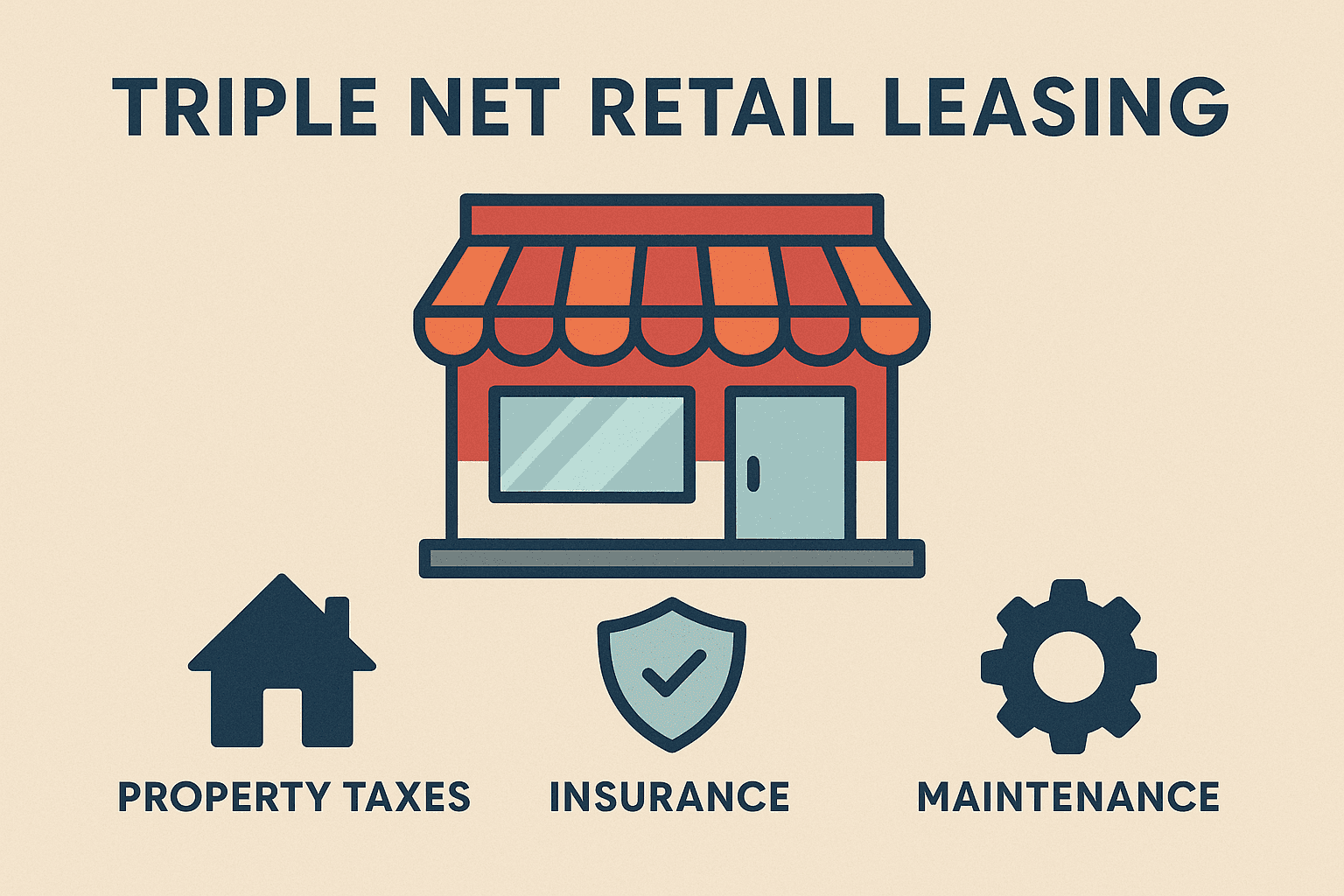
A triple net lease is a commercial lease structure where the tenant pays base rent plus three additional expense categories: property taxes, building insurance, and common area maintenance (CAM). Unlike gross leases where the landlord absorbs these costs, NNN leases pass virtually all property operating expenses through to tenants, making them responsible for their proportionate share based on the square footage they occupy.
In Houston's retail market, NNN leases are the dominant structure for strip centers, power centers, and freestanding retail buildings. Landlords prefer this arrangement because it stabilizes their net operating income—they receive predictable rent checks while tenants absorb the volatility of rising property taxes, insurance premium spikes after major storms, and fluctuating maintenance costs.
The "triple net" terminology refers to the three "nets" deducted from gross lease value: real estate taxes (first net), building insurance (second net), and maintenance expenses (third net). Some markets use "net lease" to describe variations where tenants pay one or two of these categories, but in Houston retail, when brokers say "NNN," they typically mean the tenant pays all three plus base rent.
Understanding NNN lease costs is critical for tenant representation negotiations, because these pass-through expenses can dramatically alter your effective occupancy cost compared to the quoted base rent. A $25/SF base rent might sound competitive until you discover the NNN expenses add another $14/SF, bringing your true cost to $39/SF—potentially above market for that submarket.
Base Rent vs. Triple Net Expenses: Houston Retail Breakdown
Base rent in Houston retail typically ranges from $18-45 per square foot annually depending on the property class, location, and tenant improvements. Class A power centers along I-10 Energy Corridor or Memorial City command $30-45/SF base rent, while neighborhood strip centers in outer submarkets like Cypress or Pearland might quote $18-25/SF.
But base rent is only the starting point. Triple net expenses in Houston retail properties generally add $8-16 per square foot annually, with significant variation based on property age, management efficiency, and geographic risk factors. Here's how the components typically break down:
Property Taxes: $3.50-7.00/SF annually (Harris County rates are approximately 2.7-3.1% of assessed value, varying by municipal utility district and special improvement districts)
Insurance: $1.50-4.00/SF annually (coastal properties and those in flood zones pay premiums 60-150% higher than inland locations)
CAM Charges: $3.00-6.50/SF annually (varies dramatically based on property amenities, landscaping scope, and management practices)
A typical Houston retail tenant in a well-maintained strip center might see an NNN expense package of $10-12/SF on top of $24/SF base rent, creating a total occupancy cost of $34-36/SF. However, properties with deferred maintenance, inefficient management, or recent storm damage can push NNN expenses to $15-18/SF, dramatically altering lease economics.
The challenge for tenants is that NNN expenses are estimates at lease signing. Landlords provide a base year expense projection, but actual costs fluctuate annually. Houston property taxes increased an average of 6-8% annually from 2020-2024 across most commercial districts, while insurance costs spiked 40-65% following Hurricane Harvey and again after the 2021 winter storm. Tenants bear 100% of these increases in a pure NNN structure.
Smart tenants negotiate expense caps or controllable vs. uncontrollable expense definitions to limit exposure to the landlord's management decisions while accepting market-driven increases in taxes and insurance they cannot control.
Common Area Maintenance (CAM) Charges in Houston Centers
CAM charges represent the most variable and commonly disputed component of Houston retail NNN leases. These expenses cover all costs to maintain, operate, and repair shared spaces—parking lots, landscaping, exterior lighting, signage, HVAC for common areas, management fees, and snow removal (rare in Houston, but still in many lease templates copied from northern markets).
In Houston strip centers, CAM charges typically range from $3.00-5.50 per square foot annually for basic properties with minimal common area amenities. Power centers with extensive landscaping, monument signage, structured parking, and active property management can run $5.50-8.00/SF. Lifestyle centers with significant common area features (fountains, outdoor seating, event spaces) occasionally exceed $8-10/SF in CAM.
The largest CAM line items in Houston retail properties include:
Parking lot maintenance: Resurfacing, restriping, lighting repairs, and drainage management (Houston's clay soil and heavy rainfall cause significant parking lot deterioration—expect major resurfacing every 8-12 years at $3-5 per square foot of paved area)
Landscaping: Mowing, irrigation, seasonal plantings, and tree trimming (Houston's long growing season means higher annual costs compared to northern markets)
Property management fees: Typically 3-5% of total rent collections, though some landlords charge flat monthly fees
Utilities for common areas: Exterior lighting, monument signage lighting, and any climate-controlled common spaces
Insurance deductibles: When storm damage occurs, landlords often pass through their insurance deductible as a CAM charge across all tenants
The most problematic CAM charges are capital expenditures disguised as maintenance. Landlords sometimes include roof replacements, parking lot reconstruction, or HVAC system upgrades in annual CAM reconciliations rather than amortizing them as capital improvements. Sophisticated tenants negotiate lease language that explicitly excludes capital expenditures from CAM or limits them to routine replacements under a specific dollar threshold.
Houston tenants should also scrutinize management fees calculated as a percentage of CAM expenses—this creates a perverse incentive where the property manager benefits from higher expenses rather than cost control. Negotiate a fixed monthly management fee or cap the percentage calculation at a reasonable threshold.
CAM reconciliation timing matters in Houston's volatile cost environment. Most leases require annual reconciliation within 90-120 days after year-end, but some landlords delay reconciliations or bundle multiple years together, creating large unexpected bills. Insist on timely annual reconciliation and a contractual right to audit CAM expenses with detailed supporting invoices.
Property Tax Pass-Throughs: What Houston Retail Tenants Should Expect
Property taxes represent the largest and least controllable NNN expense component for Houston retail tenants. Harris County's total tax rate for commercial properties typically ranges from 2.7-3.1% of assessed value, combining county, city, school district, and municipal utility district (MUD) levies. Fort Bend and Montgomery counties show similar ranges, though specific MUD districts can push total rates above 3.2%.
For tenants, property tax pass-throughs typically cost $3.50-7.00 per square foot annually depending on the property's assessed value and improvement quality. A 3,000 SF retail space in a Memorial-area strip center assessed at $2.8 million total building value might generate $84,000 in annual property taxes, which the landlord passes through proportionately to all tenants based on their share of the building's gross leasable area (GLA).
The timing of property tax increases creates cash flow challenges for Houston tenants. The Harris County Appraisal District (HCAD) conducts annual assessments, but values can spike dramatically in appreciating submarkets. Properties in gentrifying areas like East Downtown, Montrose, or the Heights have seen assessed values increase 40-80% over three-year periods, directly translating to tenant tax bill increases of similar magnitude.
Most Houston NNN leases structure property tax pass-throughs using one of two methods:
Base year structure: Tenant pays their pro-rata share of any property tax increase above a base year (typically the year the lease commences). If taxes were $5.00/SF in year one and increase to $5.50/SF in year two, the tenant pays the $0.50/SF increase.
Direct pass-through: Tenant pays their full pro-rata share of actual property taxes each year with no base year protection. This method is more common in Houston retail and exposes tenants to 100% of tax increases.
Tenants should understand their landlord's property tax protest strategy. Many Houston commercial landlords hire property tax consultants to file annual protests with HCAD seeking assessment reductions. Successful protests reduce tenant tax pass-throughs, but not all landlords actively protest, and some accept HCAD's initial valuation. During lease negotiations, ask whether the landlord commits to filing annual protests and whether they'll share tax savings with tenants if protests succeed after the lease year has been reconciled.
The 10% Texas homestead cap does not apply to commercial properties. Your retail space can experience unlimited annual assessment increases, and you'll pay your proportionate share of 100% of that increase in a standard NNN lease. This makes property tax exposure one of the most significant financial risks in Houston retail leases, particularly in rapidly appreciating submarkets.
Insurance Costs in NNN Leases: Hurricane and Liability Considerations
Insurance represents the most volatile NNN expense component in Houston retail leases, with premiums fluctuating dramatically based on storm activity, flood zone designation, and the broader coastal property insurance market. Hurricane Harvey in 2017, the 2021 winter storm, and subsequent coastal storm activity pushed Houston commercial property insurance premiums 60-120% higher than pre-Harvey levels, and these increases flow directly to retail tenants through NNN pass-throughs.
Landlords typically carry three primary insurance policies with costs passed through to tenants:
Property insurance: Covers the building structure, roof, exterior walls, parking lots, and landlord-owned systems (HVAC, electrical, plumbing). Premiums typically range from $0.80-2.50/SF annually for inland Houston properties, but coastal or flood-prone locations can see $2.50-4.00/SF or higher.
Liability insurance: Covers slip-and-fall claims, parking lot accidents, and other premises liability. Generally $0.30-0.75/SF annually.
Flood insurance: Required for properties in FEMA-designated flood zones. Premiums vary dramatically—$0.40-1.50/SF depending on flood zone classification (A, AE, X) and the building's elevation relative to base flood elevation.
Houston's proximity to the Gulf Coast and history of catastrophic storm events makes insurance the most unpredictable NNN expense. After Hurricane Harvey, many Houston commercial landlords saw property insurance renewals increase 70-100%, with some coastal properties becoming nearly uninsurable in the standard market. Landlords shifted to surplus lines carriers or joined the Texas FAIR Plan, both of which charge significantly higher premiums that tenants ultimately absorb.
The 2021 winter storm created a secondary insurance crisis when frozen pipes caused billions in interior damage across Houston commercial properties. Many landlords discovered their policies had significant water damage exclusions or high deductibles, and renewal premiums spiked again. Tenants faced not only higher insurance pass-throughs but also special assessments for the landlord's deductible when filing claims.
Sophisticated Houston retail tenants negotiate insurance cost protections in their leases:
Competitively bid requirement: Landlord must obtain at least two insurance quotes annually and select reasonably priced coverage, not necessarily the cheapest but not gold-plated coverage either
Deductible caps: Limit the landlord's ability to select policies with extremely high deductibles (some landlords choose $100K+ deductibles to lower premiums, then pass the deductible through to tenants when claims occur)
Extraordinary increase provisions: Cap annual insurance increases at 15-20% unless the landlord can document market-wide premium increases exceeding that threshold
Tenants should also verify that the landlord's insurance excludes coverage for tenant improvements and tenant personal property—you need your own tenant insurance policy for these items anyway, and you shouldn't subsidize the landlord's policy covering other tenants' spaces.
Ask your commercial real estate broker to review the insurance provision and confirm you're not paying for excessive coverage, unnecessary endorsements, or the landlord's failure to maintain the property in a condition that qualifies for standard market insurance rates.
Real-World Houston NNN Lease Examples by Retail Type
Understanding how NNN costs vary across Houston's diverse retail submarkets helps tenants benchmark lease proposals and identify above-market charges. Here are five real-world examples from recent Houston retail leases (tenant and property names anonymized):
Example 1: Strip Center Restaurant in Katy (2024)
Location: Cinco Ranch area, neighborhood strip center
Space: 2,800 SF
Base Rent: $24.00/SF ($67,200 annually)
Property Taxes: $4.20/SF ($11,760 annually)
Insurance: $1.80/SF ($5,040 annually)
CAM: $4.50/SF ($12,600 annually)
Total NNN: $10.50/SF ($29,400 annually)
Total Occupancy Cost: $34.50/SF ($96,600 annually)
This represents a typical neighborhood strip center NNN package in the Houston market. The property tax pass-through reflects Fort Bend County's slightly lower rates compared to Harris County. CAM charges include parking lot maintenance, landscaping for a moderately sized property, and standard management fees. Insurance costs are middle-market—the property isn't in a flood zone, which keeps premiums reasonable.
Example 2: Power Center Retail in Energy Corridor (2023)
Location: I-10 West near Eldridge
Space: 4,500 SF
Base Rent: $32.00/SF ($144,000 annually)
Property Taxes: $6.80/SF ($30,600 annually)
Insurance: $2.40/SF ($10,800 annually)
CAM: $7.20/SF ($32,400 annually)
Total NNN: $16.40/SF ($73,800 annually)
Total Occupancy Cost: $48.40/SF ($217,800 annually)
Power centers carry higher NNN expenses due to extensive common areas, structured parking in some cases, enhanced landscaping, and premium property locations that drive higher assessed values. This tenant's CAM includes costs for monument signage maintenance, enhanced lighting, seasonal landscaping, and active property management with frequent common area updates. Property taxes reflect the high assessed value of institutional-quality retail in a prime location.
Example 3: Rice Village Boutique Retail (2024)
Location: Rice Village shopping district
Space: 1,200 SF
Base Rent: $42.00/SF ($50,400 annually)
Property Taxes: $7.50/SF ($9,000 annually)
Insurance: $2.10/SF ($2,520 annually)
CAM: $5.80/SF ($6,960 annually)
Total NNN: $15.40/SF ($18,480 annually)
Total Occupancy Cost: $57.40/SF ($68,880 annually)
Urban retail districts like Rice Village, Highland Village, or The Heights command premium base rents but often show more efficient NNN expenses per square foot due to higher density and shared infrastructure costs across more tenants. Property taxes are high due to the premium land values near the Texas Medical Center and Rice University, but CAM charges are competitive because the property lacks extensive parking lots or large landscape areas.
Example 4: Suburban Strip Center in Spring (2023)
Location: FM 2920 corridor
Space: 1,800 SF
Base Rent: $20.00/SF ($36,000 annually)
Property Taxes: $3.80/SF ($6,840 annually)
Insurance: $1.60/SF ($2,880 annually)
CAM: $3.90/SF ($7,020 annually)
Total NNN: $9.30/SF ($16,740 annually)
Total Occupancy Cost: $29.30/SF ($52,740 annually)
Outer suburban markets offer lower base rents and typically lower NNN expenses, though not always proportionately lower. This Spring location shows modest property taxes due to Montgomery County's slightly lower rates and less expensive land values. CAM charges are efficient due to a simpler property with basic landscaping and minimal common area features. Insurance remains reasonable because the property is outside major flood zones.
Example 5: Galleria-Area Inline Retail (2024)
Location: Westheimer near Post Oak
Space: 3,200 SF
Base Rent: $38.00/SF ($121,600 annually)
Property Taxes: $7.80/SF ($24,960 annually)
Insurance: $3.20/SF ($10,240 annually)
CAM: $8.50/SF ($27,200 annually)
Total NNN: $19.50/SF ($62,400 annually)
Total Occupancy Cost: $57.50/SF ($184,000 annually)
Galleria-area retail represents Houston's highest-cost retail market. Property taxes reflect the extreme land values in this submarket—some of the highest assessed commercial values in Texas. Insurance costs are elevated due to the property's age (built 1980s, higher risk profile) and previous storm damage history that pushed the landlord into surplus lines coverage. CAM charges include valet parking services, extensive landscaping maintenance, and premium property management befitting an upscale retail corridor.
These examples illustrate how NNN costs vary by location, property class, and management philosophy. Tenants should request the prior year's actual NNN reconciliation statement during lease negotiations to verify that projected expenses align with recent history rather than accepting landlord estimates without documentation.
Hidden Costs and Cap Rate Clauses Tenants Often Miss
Beyond the primary NNN expense categories, Houston retail leases often contain hidden costs and structural provisions that significantly increase tenant occupancy expenses. Many of these provisions are buried in dense lease language or standard form sections that tenants skim without recognizing their financial impact.
Capital Expenditure Pass-Throughs
Some landlords include capital improvement costs in annual CAM reconciliations rather than treating them as landlord capital expenses. A $150,000 parking lot reconstruction might be spread across all tenants as a "pavement maintenance" CAM charge, adding $2-4/SF to that year's NNN expenses. Proper lease language should exclude capital expenditures from CAM or limit pass-throughs to minor capital items (under $5,000-10,000) that don't extend the property's useful life.
Management Fee Pyramiding
Many Houston retail leases allow landlords to charge management fees as a percentage of CAM expenses, then include the management fee itself in the CAM base used to calculate next year's fee—a compounding effect that inflates costs over time. A property with $100,000 in operating expenses and a 5% management fee pays $5,000 in management costs, but some leases then calculate the next year's 5% fee on $105,000 rather than just the actual operating expenses, creating "pyramiding."
Administrative Fees and Overhead Allocations
Landlords sometimes charge administrative fees for processing CAM reconciliations, legal fees for lease enforcement, or allocations of the landlord's corporate overhead. Unless these charges are specifically excluded in your lease, you might pay $0.15-0.40/SF annually for landlord administrative costs that bear no relationship to operating the property you occupy.
Expense Stops vs. True NNN
Some Houston retail leases are marketed as "NNN" but actually contain expense stops that function differently. An expense stop might state: "Tenant pays base rent of $28/SF plus NNN expenses above $8/SF." This means the landlord absorbs the first $8/SF of expenses and the tenant pays increases above that threshold. True NNN leases contain no expense stop—tenants pay their full proportionate share of all expenses from dollar one. Verify whether your lease contains a true NNN structure or an expense stop that provides some protection against cost increases.
Gross-Up Provisions for Vacant Spaces
When a retail center has vacant spaces, the landlord continues paying taxes and insurance on the entire building but collects NNN reimbursements only from occupied tenants. "Gross-up" provisions allow landlords to calculate variable CAM expenses (utilities, management fees, landscaping) as if the building were fully occupied, preventing occupied tenants from absorbing the full cost of operating half-empty properties. Landlords argue this prevents cost spikes when tenants vacate; tenants argue it allows landlords to charge for services not actually provided. Negotiate gross-up provisions carefully—they should apply only to variable CAM expenses, never to fixed costs like property taxes and insurance that don't change based on occupancy.
Audit Rights and Reconciliation Deadlines
Many Houston retail leases give tenants the right to audit CAM charges but impose onerous conditions: audits must be completed within 60 days, tenant pays audit costs unless errors exceed 5%, and the audit can only challenge the current year's charges. Negotiate for at least 90-120 days to complete audits, the ability to audit multiple years simultaneously, and a lower error threshold (2-3%) that triggers landlord responsibility for audit costs.
Reserve Accounts and Pre-Funding
Some landlords require tenants to pre-fund CAM reserves for anticipated major expenses (roof replacement, HVAC system upgrades). Unless these reserves are held in interest-bearing accounts with annual accountings and refunds when you vacate, you're providing the landlord an interest-free loan. Negotiate language requiring that any reserve accounts be held separately, accrue interest for tenant benefit, and be refunded proportionately if you vacate before the reserved expense occurs.
Tenants working with experienced commercial real estate brokers catch these hidden costs during lease negotiation rather than discovering them years later during CAM reconciliation disputes. The time to address these provisions is before you sign, not when you receive an unexpected $8,000 bill for your share of a new roof the landlord installed without notice.
Negotiating Your Houston NNN Lease: Tenant Protections Worth Fighting For
Sophisticated Houston retail tenants don't simply accept landlord-standard NNN lease forms. The following negotiation points can save tenants thousands of dollars annually and prevent disputes over expense pass-throughs:
1. Detailed Expense Definitions and Exclusions
Insist on comprehensive definitions of what constitutes CAM, property taxes, and insurance, along with explicit exclusions. Your lease should specifically exclude: costs of initial construction, capital improvements that extend property life beyond routine replacements, landlord's income taxes, leasing commissions, costs of disputes with other tenants, fines resulting from landlord's violation of laws, and any costs reimbursed by insurance proceeds.
2. CAM Caps or Controllable Expense Caps
In rising-cost environments like Houston, negotiate caps on annual CAM increases. A 4-6% annual cap on controllable expenses (landscaping, janitorial, management fees) protects you from poor landlord cost management while still allowing pass-through of uncontrollable expenses like property tax and insurance increases you both face. Some tenants negotiate absolute dollar caps: "Total NNN expenses shall not exceed $12/SF in year one, increasing by no more than 5% annually."
3. Competitive Bidding Requirements
Require landlords to obtain competitive bids for major services (landscaping contracts over $20,000, roof repairs over $50,000, parking lot resurfacing). This prevents landlords from using affiliated vendors at inflated prices or awarding contracts to friends without market verification of pricing.
4. Right to Contest Property Tax Assessments
Reserve your right to file independent property tax protests with Harris County Appraisal District if you believe the landlord isn't aggressively pursuing tax reductions. Some leases prohibit tenants from filing protests, forcing you to accept the landlord's tax strategy. Maintain your independent right to protest, and structure the lease so you benefit from any tax savings your protest generates.
5. Reconciliation Timing and Detailed Documentation
Require annual NNN expense reconciliation within 90 days after year-end, with detailed line-item documentation including vendor invoices for expenses exceeding $2,500. Many disputes arise from landlords providing summary reconciliations months late without supporting documentation. Your lease should mandate specific deliverables: "Landlord shall provide annual reconciliation by March 31 following each calendar year, including detailed general ledger, vendor invoices for expenses exceeding $2,500, property tax bills, insurance declarations pages, and management company statements."
6. Expense Audit Rights Without Penalties
Negotiate broad audit rights exercisable within 12 months after receiving reconciliation, with the ability to review multiple years simultaneously if you didn't audit earlier years. Remove provisions that penalize tenants for auditing (such as "tenant waives audit rights if reconciliation isn't disputed within 60 days") and ensure that if the audit reveals errors exceeding 3%, the landlord pays your reasonable audit costs including CPA fees.
7. Personal Guaranty Limitations Related to NNN Costs
If your lease requires a personal guaranty, limit guaranty exposure to base rent and negotiated NNN estimates, not unlimited pass-through expenses. A guaranty that covers "all tenant obligations including NNN expenses" could expose you to unlimited personal liability if property taxes triple or the landlord makes poor insurance choices. Cap guaranty exposure at base rent plus 120% of estimated NNN expenses, or negotiate a "good guy guaranty" that terminates when you vacate and surrender the space.
8. Assignment and Sublease NNN Treatment
If you plan to assign or sublease the space, clarify how NNN expenses are allocated. Can you charge your subtenant the actual NNN pass-throughs you're paying the landlord, or are you limited to the NNN estimates from your lease's first year? Can you mark up NNN pass-throughs to cover your administrative costs? Clear assignment language prevents disputes when you need to exit the lease early.
Houston retail tenants benefit from engaging tenant representation brokers who negotiate leases daily and understand which provisions landlords will modify versus hard-line requirements. The leverage point is pre-lease signing—once you've executed the lease, you're bound by its terms for the entire 5-10 year term, and landlords have little incentive to modify expense structures mid-term.
The most successful negotiations occur when tenants approach NNN lease discussions with data: comparable expense levels from similar properties, examples of favorable language from other leases in the market, and documentation of why specific landlord proposals are above market. Landlords respond to evidence-based negotiation rather than blanket demands for tenant-favorable terms without market justification.
If you're evaluating Houston retail space and need help analyzing NNN lease proposals or negotiating expense protections, reach out to our team at Bulldog Broker CRE. We represent tenants across Houston's retail submarkets and have extensive experience benchmarking NNN costs and negotiating lease protections that actually matter when the first CAM reconciliation arrives.
Frequently Asked Questions
What are typical NNN charges for Houston retail space?
NNN charges in Houston retail typically run $6–$18 per SF per year on top of base rent, depending on submarket, center type, and property age. Grocery-anchored and Class A power centers on the higher end ($12–$18/SF), strip centers and older neighborhood retail on the lower end ($6–$10/SF). Tenants underwriting a Houston retail lease should budget for CAM to grow 3–5% annually on top of the base.
How is CAM calculated on a Houston retail lease?
CAM (Common Area Maintenance) on a Houston retail lease is typically pro-rated by leased square footage as a percentage of gross leasable area (GLA). Landlord tallies actual annual expenses — landscaping, parking-lot maintenance, security, common utilities, management fees — then reconciles to the estimate charged monthly. Tenants should negotiate CAM audits and caps on controllable expenses (typically 5–8% year-over-year).
What is included in Houston triple net charges?
Standard Houston NNN includes property taxes, insurance (landlord's building coverage), and CAM (Common Area Maintenance). Some landlords also pass through management fees (typically 3–5% of gross rent), roof and structural reserves, and non-recoverable capital items — always negotiate exclusions in the LOI, not the lease.
How often do NNN charges reconcile in Houston?
Landlords typically reconcile CAM once per year — usually within 90 days of calendar year-end. Tenants receive a statement showing actual vs. estimated charges and either a credit or a true-up invoice. Right-to-audit clauses (usually 60–180 days from receiving the statement) are standard for institutional tenants and should be negotiated into every lease.
Can I negotiate a cap on CAM increases in a Houston retail lease?
Yes — annual caps on controllable CAM expenses are common and negotiable. Institutional tenants regularly get 5% year-over-year caps on controllable items (landscaping, snow removal, security, management fees). Non-controllable expenses like insurance, property taxes, and utilities typically pass through uncapped, but can be negotiated with a floor of comparable market rates.
What is the difference between NNN and gross lease in Houston?
In a triple net (NNN) lease, tenant pays base rent plus their share of taxes, insurance, and CAM. In a gross lease, landlord pays all operating expenses out of the higher base rent — tenant only pays the quoted rent. Houston retail overwhelmingly operates on NNN structures; gross leases are more common in Houston office. Compare total occupancy cost, not just base rent, when evaluating either structure.

Licensed commercial real estate broker serving New Jersey and Houston, TX. 25+ years of cross-industry experience across aerospace, oil & gas, technology, and manufacturing — applied to landlord representation, tenant rep, investment sales, and CRE consulting.
Continue reading
All blog →Where Amazon, FedEx & UPS Lease Industrial Space
Discover where Amazon, FedEx, UPS and other carriers lease last-mile delivery hubs in Houston. Maps, square footage, lease rates and emerging submarkets.
Class A vs Class B Warehouses in Katy-Brookshire: Which 3PL Property Type Delivers Better ROI?
Choosing between Class A and Class B warehouses in Katy-Brookshire? Learn which property type delivers the best ROI for 3PL operations along I-10.
Houston Flex Space vs. Traditional Office: A Cost Breakdown for Small Businesses
Compare Houston flex space and traditional office costs for small businesses. Real pricing data, hidden fees, and market insights from a licensed CRE broker.
How we can help
Talk to a licensed broker about your specific transaction — Houston + New Jersey.