


30-Foot Clear Warehouses in Houston: Where to Find Them (2026)
Houston's industrial market has undergone a dramatic transformation over the past decade, with developers increasingly building to the specifications demanded by third-party logistics providers, e-commerce fulfillment operations, and automated distribution centers. One of the most sought-after features in this new generation of warehouse space is 30-foot clear height — a benchmark that allows for double-deep racking, maximizes cubic storage efficiency, and future-proofs facilities for automation.
But not all Houston submarkets offer equal access to this type of space. Inventory concentration varies widely from the port-adjacent facilities in Bayport to the cross-dock hubs along I-10 West, and lease rates reflect both the scarcity of modern product and the logistical advantages of each corridor.
In this guide, we'll map where 30-foot clear height warehouse inventory is concentrated across Greater Houston, what tenants are currently paying in each submarket, and which factors beyond ceiling height should influence your site selection. Whether you're a regional distributor expanding into Texas or a national tenant evaluating Houston against Dallas or San Antonio, understanding the nuances of clear height supply will sharpen your negotiating position and help you avoid costly mismatches between space and operation.
By Angelo Mitlo, Licensed CRE Broker (TX License #9008834 / NJ) — specializing in tenant representation and industrial site selection across Houston's major logistics corridors.
Why 30-Foot Clear Height Matters for Modern Distribution
Clear height requirements have evolved from a nice-to-have to a non-negotiable specification for most institutional-grade warehouse users. The shift is driven by three converging factors: racking technology, labor costs, and the economics of cubic footage versus floor plate.
Maximizing Cubic Storage Efficiency
A 30-foot clear height warehouse allows operators to install racking systems that reach 26-28 feet, typically supporting five or six pallet positions vertically. Compared to a legacy 24-foot clear building (limited to three or four positions), this represents a 40-60% increase in storage density on the same footprint. For tenants paying $6-8 per square foot annually, the ability to double storage capacity without doubling rent is a direct margin enhancement.
Compatibility with Modern Material Handling Equipment
Automated guided vehicles (AGVs), autonomous mobile robots (AMRs), and automated storage and retrieval systems (AS/RS) all require adequate vertical clearance not just for the racking itself but for the equipment that services it. Reach trucks, turret trucks, and order pickers operating at full extension need clearance buffers; 30-foot ceilings provide the operating envelope these systems demand.
Future-Proofing for Automation and Robotics
Even tenants not currently running automated systems recognize that a 30-foot clear height warehouse in Houston preserves optionality. Retrofitting automation into a 22-foot legacy building is often cost-prohibitive; starting with modern clear height requirements means you won't outgrow the space as operations evolve. This is particularly relevant for e-commerce fulfillment operations and third-party logistics providers planning multi-year expansions.
Labor Productivity and Safety Considerations
Higher clear heights, when paired with narrow-aisle racking and modern forklifts, reduce the number of times workers need to move product horizontally. Instead of sprawling single-story layouts requiring long travel distances, operators can stack vertically and pick more efficiently. This translates to fewer labor hours per order line and reduced risk of incidents in high-traffic aisles.
Houston Submarkets with the Most 30-Foot Clear Inventory
Not all of Greater Houston's 1.1 billion square feet of industrial space was built to modern specifications. The majority of 30-foot clear height warehouse Houston inventory has been delivered since 2015, concentrated in submarkets where land costs, highway access, and tenant demand converged.
Bayport and East Houston: The Port-Proximate Leader
The Bayport submarket, anchored by State Highway 146 and Beltway 8 East, contains the highest concentration of Class A, 30-foot clear buildings in the metro. Proximity to the Port of Houston's Barbours Cut and Bayport Container Terminals drives demand from import-dependent users — consumer goods distributors, drayage operators, and transload facilities. Developers have responded with speculative construction averaging 200,000-500,000 square feet, nearly all featuring 30-foot to 32-foot clear heights, ESFR sprinkler systems, and 50+ dock doors.
North Houston and the I-45 Corridor
The I-45 North corridor from Beltway 8 to FM 1960 has emerged as Houston's e-commerce and last-mile hub. Amazon, Walmart, FedEx, and UPS have all established fulfillment or sortation facilities here, creating a cluster effect that attracts ancillary logistics providers. The submarket offers a mix of big-box facilities (500,000+ SF) and mid-bay options (100,000-250,000 SF), most built to 30-foot or 32-foot clear specifications. Land costs are higher than East Houston but still competitive with Dallas-Fort Worth equivalents.
West Houston: Katy, Energy Corridor, and I-10 West
The I-10 West corridor from Highway 6 to Katy has seen aggressive speculative development, particularly in the 99 Grand Parkway area. This submarket appeals to cross-dock operations, food and beverage distributors, and energy-related logistics given its access to both I-10 (transcontinental freight route) and the Energy Corridor's chemical and refining industries. Clear height inventory here skews toward 200,000-400,000 SF buildings, with rent premiums justified by lower truck congestion and newer infrastructure compared to central Houston.
Northwest Houston and Beltway 8
The Northwest submarket (roughly between US 290 and I-45, bounded by Beltway 8) offers a middle ground between port proximity and central Houston access. Clear height inventory here is more fragmented — a mix of 2000s-era 28-foot buildings and newer 30-32 foot product. This submarket attracts general merchandise distributors, furniture logistics, and building materials suppliers. Vacancy rates tend to run slightly higher than East or North Houston, creating negotiating leverage for tenants willing to consider secondary locations.
Emerging Inventory in Conroe and the 99 Corridor
The Grand Parkway (Highway 99) has unlocked land north of Houston in Conroe and south toward Pearland. While still a smaller share of total inventory, developers are increasingly building 30-foot clear spec buildings in these outlying markets to capture tenants priced out of core submarkets or seeking greenfield sites for build-to-suit expansions. Lease rates here can run $1.00-1.50/SF below comparable Bayport product, but tenants trade off some labor pool depth and highway redundancy.
Current Pricing for 30-Foot Clear Height Space in Houston
Lease rates for 30-foot clear height warehouses in Houston vary by submarket, building age, and tenant improvements, but the metro remains one of the most cost-competitive major logistics markets in the U.S. The table below reflects market averages as of Q1 2024 for Class A space (built post-2015, ESFR sprinklers, LED lighting, 30+ foot clear, truck court depth 130+ feet).
Houston Warehouse Lease Rates by Submarket (30-Foot Clear)
SubmarketAverage NNN Rate ($/SF/Yr)Vacancy RateTypical Building SizeBayport / East Houston$6.75 - $7.504.2%200K-500K SFNorth Houston (I-45)$7.00 - $8.253.8%150K-600K SFWest Houston (Katy / I-10)$6.50 - $7.755.1%200K-400K SFNorthwest Houston (290/I-45)$5.75 - $6.756.3%100K-300K SFSouth Houston (Pearland / 288)$6.25 - $7.255.5%150K-350K SFConroe / North 99 Corridor$5.25 - $6.257.8%100K-250K SFBeaumont (Port Arthur corridor)$4.50 - $5.509.2%75K-200K SF
Rates shown are triple-net (NNN) base rent; operating expenses (CAM, taxes, insurance) typically add $1.25-2.00/SF annually. Data sourced from CoStar and CBRE Q1 2024 Houston Industrial Market Report.
How Houston Compares to Other Texas Markets
For context, comparable 30-foot clear warehouse space in Dallas-Fort Worth currently leases at $7.50-9.50/SF NNN, and Austin commands $8.00-10.00/SF due to constrained land supply. Houston's pricing advantage stems from abundant developable land, lower property taxes in unincorporated areas, and a regulatory environment that streamlines permitting for industrial projects. Tenants evaluating multi-market Texas strategies should weigh Houston's cost structure against DFW's slightly stronger labor availability and Austin's tech-sector workforce density.
East Houston (Bayport, Deer Park): Port-Proximate Options
The Bayport submarket is the undisputed leader in Houston's 30-foot clear height warehouse supply, driven by its role as the primary logistics gateway for containerized imports entering the Southwest U.S.
Strategic Advantages of Bayport Locations
Facilities within a 10-mile radius of the Bayport Container Terminal eliminate one full day of drayage time for import-dependent operations. For tenants moving consumer goods, automotive parts, or retail merchandise, this proximity reduces per-container logistics costs by $75-150 and minimizes risk of port congestion delays. Direct access to State Highway 146 and Beltway 8 East also simplifies outbound distribution to San Antonio, Austin, and Dallas markets.
Typical Building Characteristics
Bayport warehouse inventory built since 2018 typically features 32-foot clear heights (exceeding the 30-foot baseline), 185-foot truck court depths to accommodate container chassis staging, and dock door spacing at 12-foot centers. Many buildings include dedicated container storage yards, transload bays, and rail spurs for intermodal transfer. ESFR (Early Suppression Fast Response) sprinkler systems are standard, enabling high-pile storage configurations that maximize the cubic capacity afforded by tall ceilings.
Tenant Profile and Competition
The submarket attracts import-heavy users: furniture distributors, apparel logistics providers, consumer electronics 3PLs, and chemical transloaders. Competition for space intensified following Amazon's 2019 delivery station opening and subsequent expansions by third-party logistics operators. Vacancy in Bayport's Class A 30-foot clear inventory has remained below 5% since 2021, giving landlords leverage in lease negotiations and limiting tenant improvement concessions.
Lease Rate Drivers Specific to Bayport
While Bayport's $6.75-7.50/SF NNN rates sit near the Houston average, the effective cost per container handled or per TEU stored is often lower than alternative sites once drayage and detention fees are factored in. Tenants should model total landed costs — including chassis rental, port accessorial charges, and labor rates for unloading — rather than fixating on base rent alone.
North Houston & I-45 Corridor: E-Commerce & Last-Mile Hubs
The I-45 North corridor has become Houston's answer to the Inland Empire or New Jersey Turnpike — a dense cluster of fulfillment centers, sortation hubs, and last-mile delivery stations serving same-day and next-day consumer expectations.
Why E-Commerce Operators Favor North Houston
North Houston offers central proximity to the metro's 7+ million consumers, direct highway access to both George Bush Intercontinental Airport (IAH) and I-45 South (Galveston/Port of Houston), and a deep labor pool along the FM 1960 and Greenspoint corridors. For e-commerce operators optimizing for delivery speed, a North Houston 30-foot clear height warehouse enables stocking high-velocity SKUs close to end customers while maintaining the vertical density needed for inventory breadth.
Building Specifications Optimized for Fulfillment
Unlike Bayport's import-focused facilities, North Houston warehouses often prioritize high dock door counts (60-100+ doors in big-box facilities) over rail access or container yards. Clear heights of 30-32 feet support automated sortation conveyors, pick modules, and mezzanine pack stations. Developers here increasingly deliver "fulfillment-ready" shells with reinforced floor slabs rated for 1,000+ PSF (to support multi-level racking) and electrical service sized for robotic systems (2,000-4,000 amps).
Submarket Micro-Zones: Greenspoint vs. FM 1960 vs. Generation Park
Not all of North Houston offers equal appeal. The Greenspoint area (I-45 at Beltway 8) features older building stock with limited 30-foot inventory but lower land costs; FM 1960 East has seen aggressive Class A spec construction since 2020; and Generation Park (near the Hardy Toll Road) offers master-planned industrial parks with newer infrastructure. Lease rates can vary by $1.00-1.50/SF across these micro-zones despite being within five miles of each other.
Case Study: Mid-Sized 3PL Expansion
A regional third-party logistics provider recently leased 175,000 SF at $7.40/SF NNN in the FM 1960 corridor (30-foot clear, 2022 vintage). The tenant negotiated $25/SF in tenant improvement allowances to install narrow-aisle racking, LED motion-sensor lighting, and a mezzanine office build-out. Compared to alternative sites in West Houston (quoted at $6.75/SF but 12 miles farther from IAH), the North Houston location reduced average outbound delivery time by 35 minutes, justifying the rent premium through lower last-mile transportation costs.
West Houston (Katy, Energy Corridor): Cross-Dock & Rail Access
The I-10 West corridor offers a different value proposition: lower rent than North Houston, superior rail connectivity, and access to the Energy Corridor's industrial base for chemical, pipe, and equipment distribution.
Cross-Dock Economics Along I-10
I-10 is the primary transcontinental freight route linking Houston to San Antonio, El Paso, and Southern California. For distributors running cross-dock operations (receiving full truckloads, breaking into less-than-truckload shipments, and re-shipping within 24-48 hours), proximity to I-10 minimizes dwell time and avoids the truck congestion common in central Houston. A 30-foot clear height warehouse in Katy, TX allows cross-dock operators to stage inbound freight vertically when dock congestion occurs, rather than spilling onto expensive yard storage.
Rail-Served Facilities and Intermodal Access
Several West Houston industrial parks offer Union Pacific or BNSF rail spurs, a rarity in other Houston submarkets. Tenants moving bulk commodities, steel, plastics, or heavy machinery can leverage rail for inbound linehaul and truck for final-mile delivery. The 30-foot clear height specification supports overhead crane installations for unloading railcars directly into racking systems.
Energy Corridor Synergies
The Energy Corridor (roughly I-10 between Highway 6 and the Sam Houston Tollway) remains home to hundreds of upstream and midstream energy companies. While not traditionally a logistics hub, the area supports specialized warehouse users: oilfield equipment distributors, valve and fitting suppliers, and chemical packaging operations. These tenants value 30-foot ceilings for stacking pipe, drill bits, and casing, and often require yard storage for oversized freight — a use case well-suited to West Houston's larger land parcels.
Rent and Concession Trends
West Houston's $6.50-7.75/SF NNN range reflects both newer product (driving rates toward the high end) and secondary locations with less institutional ownership (driving rates lower). Tenant improvement allowances in this submarket average $15-20/SF for vanilla box buildings, with landlords willing to negotiate higher allowances for credit tenants signing 7-10 year terms. Renewal options are typically more favorable here than in tighter North or East submarkets.
What Drives Premium Pricing Beyond Clear Height
While 30-foot clear height is a baseline specification for modern warehouse users, it's only one variable in a multi-factor site selection equation. Understanding what else drives premium pricing helps tenants avoid overpaying for features they don't need — or undervaluing amenities that reduce operating costs.
Dock Door Count and Truck Court Depth
A building advertised as "30-foot clear, 200,000 SF" might have 20 dock doors or 60; that difference fundamentally changes throughput capacity. High-velocity operations (e-commerce, food distribution) require one dock door per 2,500-3,500 SF of building area, while slower-turn wholesale or storage uses function with one per 8,000-10,000 SF. Similarly, truck court depth matters: 130 feet allows simultaneous trailer staging and maneuvering, while 100 feet creates bottlenecks. Expect to pay $0.50-1.00/SF more annually for buildings with dock-door-to-square-footage ratios above industry averages.
Floor Load Capacity and Slab Quality
Clear height is useless if the floor can't support the weight of loaded racking. Older warehouses often feature 500-600 PSF slab ratings; modern Class A facilities target 1,000 PSF or higher. Additionally, super-flat floors (FF/FL ratings of 50/45 or better) enable narrow-aisle racking and automated guided vehicles, both of which maximize the cubic storage enabled by 30-foot ceilings. Buildings with reinforced slabs and laser-leveled floors command $0.75-1.25/SF premiums.
Electrical Service and HVAC Capacity
Robotics, conveyors, and climate-controlled storage all require robust electrical infrastructure. A standard warehouse might deliver 600-800 amps; fulfillment-ready buildings offer 2,000-4,000 amps with 480V three-phase service. If your operation plans to retrofit automation, verify that panel capacity and transformer sizing won't require $200,000+ in upgrades. Climate control is similarly variable: some 30-foot clear warehouses are unconditioned shells, others offer partial office HVAC, and a subset (particularly in food/pharma logistics) deliver refrigerated or freezer space. Conditioned space adds $2.00-4.00/SF to base rent but may be non-negotiable for certain product types.
Site Coverage Ratio and Yard Storage
Buildings that consume 40-50% of the land parcel leave ample yard for container storage, trailer parking, or future expansion. Sites with 60%+ coverage (common in infill locations) limit operational flexibility. For port-proximate or intermodal tenants, yard footage is often as valuable as building square footage; landlords recognize this and price accordingly.
Landlord Quality and Lease Structure Flexibility
Institutional landlords (Prologis, Duke Realty, Clarion Partners) typically offer standardized lease forms, predictable operating expense pass-throughs, and responsive property management, but less flexibility on deal structure. Private or regional owners may negotiate creative terms — percentage rent for startups, expansion options at fixed rates, or TI allowances above market — but require more tenant due diligence on building condition and financial stability. The "right" landlord depends on your risk tolerance and growth trajectory.
How to Evaluate a 30-Foot Warehouse for Your Operation
Once you've identified candidate buildings in your target submarkets, a structured evaluation process ensures you don't overlook operational mismatches or hidden costs that erode the value of modern clear height specifications.
Operational Needs Assessment Checklist
Start by documenting your actual requirements, not generic industry standards:
Racking configuration: Will you run selective pallet racking (requiring wide aisles), double-deep, push-back, or drive-in systems? Each has different aisle width and clear height utilization.
Material handling equipment: Are you using standard counterbalance forklifts, reach trucks, turret trucks, or automated systems? Match equipment lift heights and aisle requirements to the building's clear height and column spacing.
SKU velocity and inventory turns: High-turn operations (8+ turns/year) benefit from horizontal layouts and high dock counts; low-turn warehousing (2-4 turns/year) maximizes 30-foot clear vertical storage.
Inbound/outbound split: Cross-dock operations need balanced dock doors on opposite sides of the building; storage-heavy operations can function with asymmetric layouts.
Labor and shift planning: If running 24/7 operations, confirm the building's proximity to residential areas with night-shift workforce availability (North Houston and East Houston excel here; outlying markets struggle).
Building Inspection: What to Look for Beyond the Spec Sheet
Tour candidate buildings with an operations manager or industrial engineer, not just a real estate decision-maker. Key inspection points include:
Column spacing: 50-foot or 55-foot spacing is ideal for racking layouts; 40-foot spacing limits flexibility and reduces usable cube.
Ceiling obstructions: Confirm that advertised clear height is measured to the lowest obstruction (HVAC ducts, sprinkler mains, light fixtures), not to the roof deck.
Dock door condition: Test levelers, seals, and lights; budget $1,500-2,500 per door for repairs if equipment is worn.
Lighting and energy costs: LED fixtures with motion sensors cut energy costs 40-60% versus older metal halide or fluorescent systems; review utility bills for the past 12 months to validate.
Fire suppression: ESFR systems allow taller storage; older conventional sprinklers may limit you to 20-24 feet of stored product regardless of ceiling height.
Lease Negotiation Strategies for Tenant Representatives
Once you've confirmed operational fit, engage a tenant representative (ideally a Texas-licensed broker familiar with Houston industrial markets) to negotiate favorable lease terms:
TI allowances: In a balanced market, expect $15-25/SF for racking, lighting, and office build-outs; push for higher allowances if signing 7+ year terms.
Rent escalations: Negotiate fixed annual increases (2.5-3.0%) rather than CPI-indexed escalations, which can spike during inflationary periods.
Expansion and contraction rights: If your growth trajectory is uncertain, secure options to expand into adjacent space or sublease excess square footage without penalty.
Lease commencement timing: Negotiate free rent during the TI construction period (typically 60-90 days for racking and mezzanine installations); don't start paying rent until you can occupy.
Operating expense caps: For NNN leases, negotiate caps on controllable expenses (management fees, landscaping) to limit year-over-year cost volatility.
Total Cost of Occupancy Modeling
Base rent is only 50-60% of your total facility cost. Model the full picture:
Base rent: $6.50-8.00/SF depending on submarket
Operating expenses (NNN): $1.25-2.00/SF (taxes, insurance, CAM)
Utilities: $0.75-1.50/SF for warehouse, $3.00-5.00/SF for climate-controlled areas
Labor costs: Varies by submarket; North Houston wage rates run 5-8% higher than Conroe or Beaumont due to competition from e-commerce fulfillment centers
Transportation costs: Model inbound drayage (if port-dependent), outbound LTL/parcel, and last-mile delivery; a $1.00/SF rent savings 20 miles from your optimal location often costs $2.00/SF in added logistics expense
Use this total cost model to compare buildings across submarkets objectively, rather than selecting the lowest base rent without context.
Engaging a Texas-Licensed CRE Broker
Texas commercial real estate transactions require broker licensing, and tenants benefit from representation by brokers who specialize in industrial logistics. Angelo Mitlo holds active licenses in both Texas (License #9008834) and New Jersey, with deep expertise in Houston's 30-foot clear height warehouse inventory, submarket pricing dynamics, and landlord negotiation strategies. Whether you're a national tenant evaluating Houston for the first time or a regional operator expanding within Texas, working with a tenant-focused broker ensures you capture the best available terms and avoid costly site selection mistakes.
For a confidential consultation on your Houston warehouse requirements, contact BulldogBroker CRE to discuss your operational needs, target submarkets, and lease negotiation strategy.
Final Takeaways: Making the Right Site Selection Decision
Houston's 30-foot clear height warehouse market offers exceptional value compared to coastal gateway markets, but success requires understanding submarket nuances, building specifications beyond ceiling height, and total cost modeling that accounts for logistics, labor, and lease structure.
Key insights to remember:
Bayport leads in port-proximate inventory; North Houston dominates e-commerce and last-mile; West Houston offers cross-dock and rail advantages
Lease rates range from $5.25/SF (outlying markets) to $8.25/SF (premium North Houston), but base rent is only one variable in total occupancy cost
Clear height alone doesn't determine operational fit — dock count, floor load, electrical capacity, and column spacing matter equally
Tenant improvement allowances, rent escalations, and expansion rights are all negotiable; don't accept landlord boilerplate without pushing back
Engage a Texas-licensed tenant representative early in the process to access off-market opportunities and level the negotiating playing field
The Houston industrial market will continue evolving as e-commerce grows, port volumes increase, and automation becomes table stakes for competitive distribution. Tenants who invest time in understanding clear height supply, submarket pricing, and operational fit will secure facilities that support growth for the next decade — not just the next lease term.
Frequently Asked Questions
What is clear height in a warehouse?
Clear height is the distance from the finished floor to the lowest overhead obstruction — usually the bottom of a joist, sprinkler head, or lighting fixture. It is the height available for stacking product, not the total building height. A 32-foot roof might only offer 30-foot clear once sprinklers and joists are accounted for. Always confirm clear height with the building owner, not just the roof height on the listing.
Which Houston submarkets have the most 30-foot clear warehouses?
The heaviest concentration of 30-foot clear warehouse inventory in Houston is along the North Fwy / Tomball Pky corridor, Katy-Brookshire, Sugar Land, and North Hardy Toll Road. These submarkets have seen the most modern bulk industrial development since 2020. Older submarkets like the Ship Channel and Southwest Far tend to offer more 24-foot and 28-foot clear inventory alongside the newer 30-foot+ product.
How much does 30-foot clear warehouse space cost in Houston?
Modern 30-foot clear industrial in Houston typically leases at $7.50–$10.50/SF NNN, depending on submarket, tenant credit, deal size, and TI package. Bulk product (250,000 SF+) trades at the low end; small-bay 30-foot clear (25,000–75,000 SF) at the high end because it is scarcer. Absorption of large-format 30-foot clear space has softened in 2026, creating tenant leverage on rents and free-rent periods.
What can I store with 30-foot clear ceilings?
30-foot clear height enables double-deep pallet racking, mezzanine installations, and future automation (AS/RS systems, high-bay conveyors). Standard 48-inch pallets stacked 5–6 high with rack framing fits comfortably in 30-foot clear; 32-foot clear allows 7 high. For e-commerce fulfillment, 30-foot clear is generally the minimum for efficient cube utilization; some newer developments spec 36 or 40 feet.
What ceiling height do I actually need for pallet racking?
Standard selective racking with 48-inch pallets fits under 24-foot clear at 4 high. Add a fifth level and you need ~28 feet. Sixth level requires 32-foot clear. Add another 6–12 inches on top for sprinkler-head clearance mandated by NFPA 13 and local fire code. If your operation is stable at 4-5 levels, you may not need 30-foot; if you are planning growth or automation, 30-foot minimum is the safe answer.
How does clear height affect warehouse insurance rates?
Clear height above 30 feet may require additional fire protection — ESFR (Early Suppression, Fast Response) sprinklers, in-rack sprinklers, or additional aisle clearance. These systems can add $0.75–$2.00 per SF to occupancy cost through amortized capex or higher NNN charges. Ask the landlord whether ESFR is already installed and whether the storage plan you propose fits within the building's existing fire protection classification.

Licensed commercial real estate broker serving New Jersey and Houston, TX. 25+ years of cross-industry experience across aerospace, oil & gas, technology, and manufacturing — applied to landlord representation, tenant rep, investment sales, and CRE consulting.
Continue reading
All blog →Where Amazon, FedEx & UPS Lease Industrial Space
Discover where Amazon, FedEx, UPS and other carriers lease last-mile delivery hubs in Houston. Maps, square footage, lease rates and emerging submarkets.
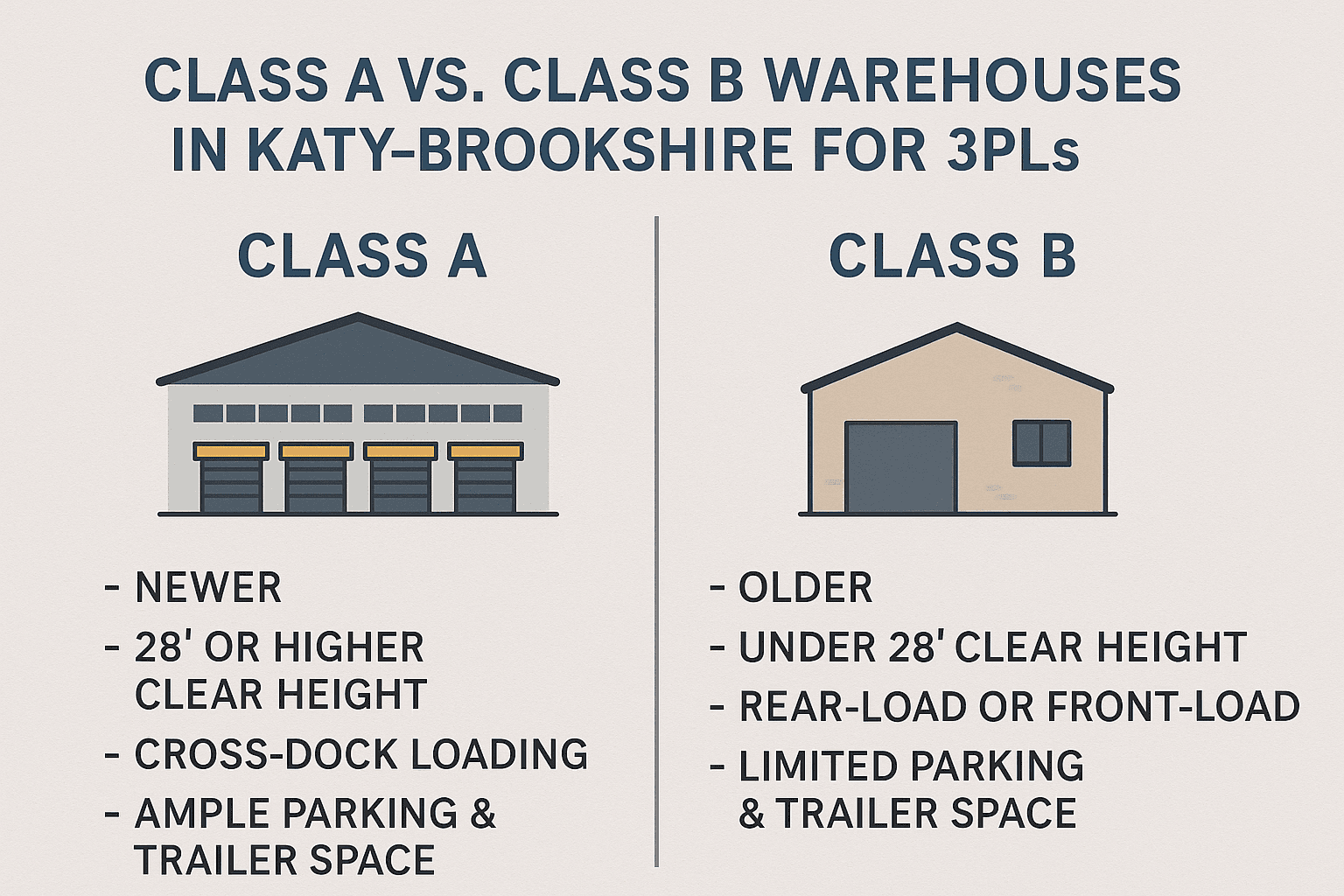
Class A vs Class B Warehouses in Katy-Brookshire: Which 3PL Property Type Delivers Better ROI?
Choosing between Class A and Class B warehouses in Katy-Brookshire? Learn which property type delivers the best ROI for 3PL operations along I-10.
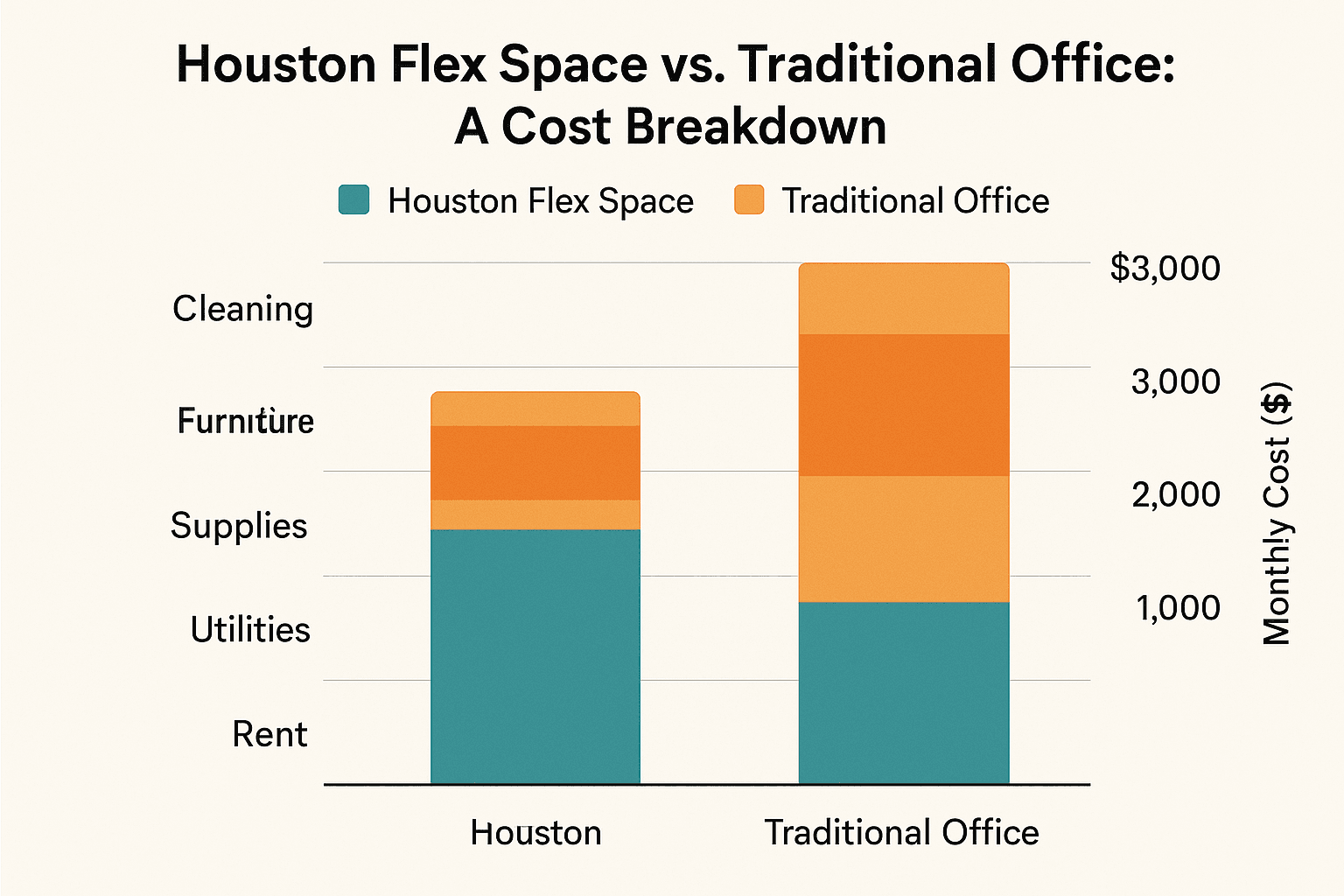
Houston Flex Space vs. Traditional Office: A Cost Breakdown for Small Businesses
Compare Houston flex space and traditional office costs for small businesses. Real pricing data, hidden fees, and market insights from a licensed CRE broker.
How we can help
Talk to a licensed broker about your specific transaction — Houston + New Jersey.