

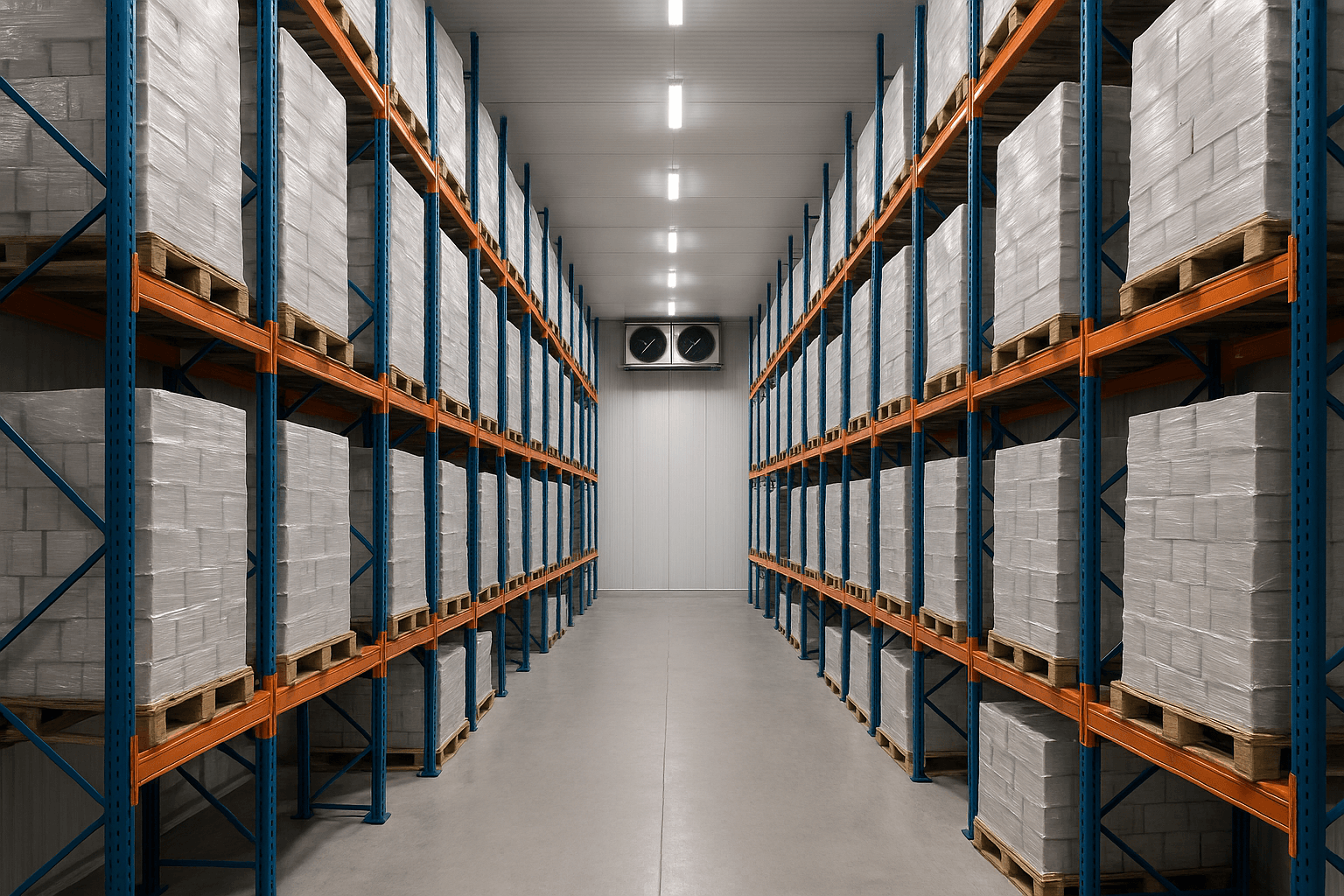
Cold Storage Warehouse Costs in Houston: Build vs. Convert
Cold storage warehouse costs in Houston have climbed dramatically since 2022, driven by surging demand from food distributors, pharmaceutical logistics providers, and e-commerce cold chain operations. Whether you're a third-party logistics provider expanding capacity or a food importer establishing a Gulf Coast presence, the fundamental question remains: should you build a purpose-designed facility or convert existing industrial space?
The answer isn't simple. A build-to-suit cold storage project in Houston typically ranges from $150–$200 per square foot for automated facilities, with typically 18–24 month delivery timelines. Conversions may cut upfront costs by 30–40% but introduce operational compromises that affect long-term profitability. Both paths demand careful analysis of your cold chain requirements, growth projections, and capital structure.
This guide breaks down the real costs, timelines, and trade-offs for both approaches in Houston's 2025 market. You'll see hard numbers from recent projects, understand what drives cost differences between build and conversion scenarios, and gain a decision framework that accounts for your specific operational needs and financial constraints.
By Angelo Mitlo, Principal Broker
Licensed in TX & NJ | 25+ years industrial experience
Last updated: January 2025
What Makes Cold Storage Different from Standard Industrial Space
Cold storage facilities operate under fundamentally different construction and operational parameters than ambient warehouse space. Understanding these distinctions is critical when evaluating Houston cold storage construction costs versus conversion scenarios.
The primary differentiator is thermal envelope integrity. Cold storage warehouses require continuous insulated panels—commonly 4–6 inches of polyurethane foam for freezer space (-10°F to 0°F) and 3–4 inches for cooler zones (32°F to 38°F)—installed on walls, ceilings, and floors. Standard Houston industrial warehouse construction uses metal panel walls with minimal insulation, making thermal retrofits expensive and complex.
Refrigeration systems represent the second major cost driver. Purpose-built cold storage facilities typically use ammonia-based refrigeration systems, which offer superior energy efficiency and lower long-term operating costs compared to Freon-based systems common in conversion projects. A 100,000-square-foot freezer facility typically requires approximately 350–450 tons of refrigeration capacity, with with ammonia systems typically costing approximately $1.2–$1.8 million for that scale.
Structural requirements also diverge significantly. Cold storage buildings need:
Reinforced floor slabs: Reinforced floor slabs: typically 6–8 inch concrete floors with vapor barriers and sub-slab heating systems to prevent frost heave, compared to 5–6 inch slabs common in standard warehouses
Higher clear heights: typically 32–40 feet to maximize cubic storage in high-cost refrigerated space, compared to 28–32 feet in typical distribution centers
Specialized dock equipment: Insulated dock doors, dock seals, and vestibules to minimize temperature loss during loading operations
Fire suppression systems: ESFR (Early Suppression Fast Response) sprinkler systems rated for cold storage applications, which typically cost substantially more than standard warehouse systems
Energy consumption patterns differ dramatically. Industry estimates suggest cold storage facilities typically consume 15–25 kWh per square foot annually, compared to 3–6 kWh for ambient warehouses. In Houston's climate, where summer temperatures regularly exceed 95°F, maintaining freezer temperatures demands continuous compressor operation and aggressive thermal management.
These fundamental differences explain why converting existing warehouse space to cold storage, while cheaper upfront, introduces operational compromises that affect long-term profitability and efficiency.
Houston's Cold Storage Market Snapshot: Demand Drivers in 2025
Houston's cold storage market has experienced unprecedented demand growth over the past three years, creating upward pressure on both cold storage warehouse costs in Houston and lease rates for existing facilities.
The Port of Houston handles a significant majority of the Gulf Coast's containerized refrigerated cargo, positioning the region as a critical gateway for imported proteins, produce, and pharmaceuticals. Container volumes through the port's Barbours Cut and Bayport terminals increased substantially in 2024, with refrigerated containers (reefers) growing at substantially faster rates.
In my experience representing cold chain operators in Houston over the past decade, three demand drivers are reshaping the market:
1. E-commerce grocery fulfillment: Amazon Fresh, Instacart, and regional grocery chains are establishing last-mile cold storage hubs throughout the metro area. These facilities—typically 30,000–80,000 square feet—require blast freezer zones, cooler staging areas, and rapid-turn dock configurations that standard distribution centers cannot support.
2. Pharmaceutical cold chain expansion: Biologics, vaccines, and specialty pharmaceuticals require temperature-controlled storage between 2°C and 8°C with continuous monitoring and backup power systems. Houston's concentration of medical institutions and proximity to Latin American distribution routes has attracted specialty pharma logistics operators, who pay premium rates for FDA-compliant cold storage space.
3. Onshoring of protein processing: Trade policy shifts and food security concerns are driving domestic expansion of meat processing and cold storage capacity. Industry estimates suggest that U.S. cold storage capacity has increased substantially in recent years, with Texas representing a significant portion of that growth—one of the highest state totals in the nation.
Industry data typically shows vacancy rates for cold storage space in Houston below 4%, compared to 7–9% for ambient industrial space. Class A automated cold storage facilities typically command lease rate premiums substantially above comparable ambient warehouse space, with industry estimates often showing cold storage rates approximately two to three times higher on a triple-net basis. This rate premium, combined with limited existing inventory, is pushing operators toward build-to-suit development rather than waiting for suitable lease opportunities.
Land costs in Houston's primary cold storage corridors...have increased significantly since 2020est Houston along I-45, and the I-10 East logistics zone—have increased 40–65% since 2020. Sites with heavy power infrastructure and rail access typically trade at approximately $8–$12 per square foot, up from approximately $5–$7 in 2020, directly impacting refrigerated warehouse pricing Houston developers must absorb.
Build-to-Suit Cold Storage: Cost Breakdown and Timeline
Build-to-suit cold storage construction in Houston provides maximum operational efficiency and customization but demands significant capital and extended timelines. Here's what the numbers actually look like in 2025.
Hard Cost Breakdown (per square foot):
Site work and utilities: typically $8–$12
Building shell (tilt-wall or insulated panels): industry estimates suggest $45–$60
Refrigeration systems (ammonia-based): typically $35–$50
Racking and material handling equipment: industry estimates suggest $25–$40
Fire suppression and life safety: typically $8–$12
Office build-out and support spaces: typically $6–$10
Contingency and testing: typically $10–$15
Total hard costs: typically $137–$199 per square foot
Soft costs add another 15–25% to the project budget:
Architecture and engineering: typically 4–6% of hard costs
Permitting and impact fees (Houston): typically $1.50–$2.50/sf
Construction financing and interest carry: 3–5% depending on timeline and rates
Development fee: typically 3–5%
Legal, insurance, and commissioning: typically 2–3%
For a 100,000-square-foot automated cold storage facility in Houston, you're looking at:
Land acquisition: 7–10 acres at market rates = typically $2.4–$5.2 million
Hard costs: $13.7–$19.9 million
Soft costs: $2.1–$5.0 million
Total project cost: approximately $18.2–$30.1 million ($182–$301/sf all-in, representative estimate based on 2025 market conditions)
These Houston cold storage construction costs assume a single-temperature zone facility with 32–36 foot clear height, ESFR fire suppression, and 30–40% office/support space ratio. Multi-temperature facilities with separate blast freezer, freezer, cooler, and dry storage zones add $15–$25 per square foot due to additional refrigeration systems and zone separation requirements.
Project Timeline:
Site selection and due diligence: 2–4 months
Permitting and design: typically 4–6 months (Houston's permitting process is relatively efficient, but refrigeration systems and fire suppression require multiple agency reviews)
Construction: typically 12–16 months for shell and core
Refrigeration system installation and commissioning: typically 2–3 months (often overlaps with construction completion)
Racking installation and operational testing: typically 1–2 months
Total timeline: typically 21–31 months from site selection to operational, though this varies by project complexity
In my experience working with build-to-suit cold storage projects in the Houston market, three factors most commonly extend timelines:
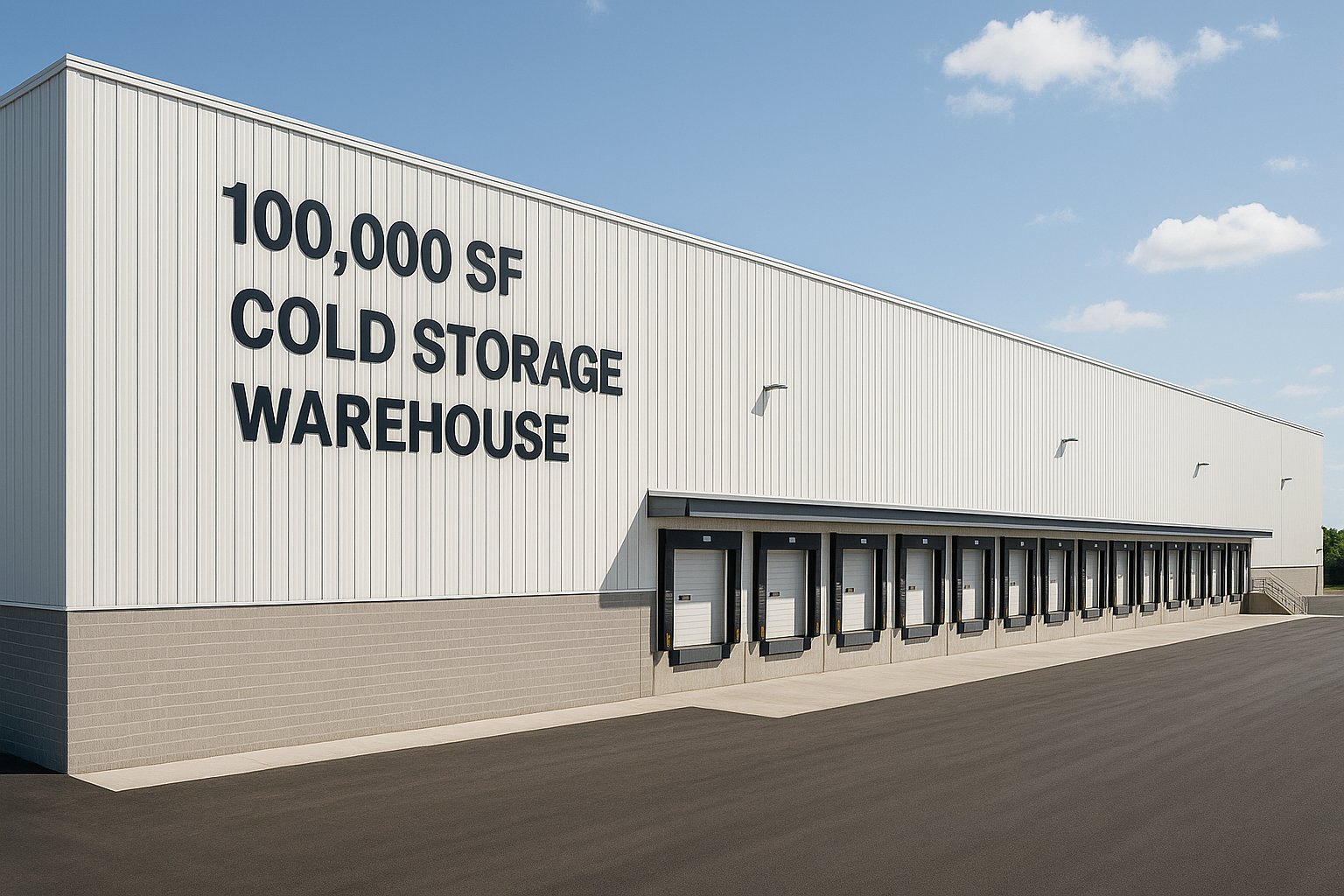
Utility infrastructure: Ammonia-based refrigeration systems typically require substantial electrical service—often in the range of 2,000–3,000 amps for a 100,000 sf facility. If the site lacks adequate power infrastructure, utility upgrades may add 4–8 months and $300,000–$800,000 to the project, depending on site conditions.
Ammonia system permitting: Industrial ammonia refrigeration systems exceeding 10,000 pounds typically require detailed Process Safety Management (PSM) plans during the permitting process. This review process typically adds 60–90 days to permitting timelines.
Equipment lead times: Evaporators, compressors, and control systems for industrial refrigeration typically have reported lead times of 16–24 weeks as of Q4 2024 from manufacturers like Johnson Controls, Mayekawa, and Evapco. Early equipment procurement is critical to avoid construction delays.
One recent example: a typical 125,000-square-foot freezer facility in t from land closing to first customer occupancy: 27 months.
Converting Existing Warehouses: When Retrofit Makes Financial Sense
Converting existing warehouse space to cold storage offers faster market entry and lower upfront capital requirements—but the economics only work under specific conditions. Here's the realistic cost structure and when conversion makes sense.
Typical Conversion Cost Breakdown (per square foot):
Insulated panel installation (walls, ceiling, floor): typically $30–$45
Refrigeration system (typically Freon-based for conversions): typically $22–$35
Floor reinforcement and vapor barrier: typically $8–$15
Upgraded electrical service: typically $6–$12
Dock modifications (seals, vestibules, insulated doors): typically $4–$8
Fire suppression upgrade: typically $6–$10
Engineering and permits: typically $3–$6
Total conversion costs: typically $79–$131 per square foot
Add the building acquisition cost—typically $40–$70 per square foot for older industrial space in Houston's secondary submarkets—and your the all-in cost typically ranges from approximately $119–$201 per square foot. This typically compares to approximately $182–$301 per square foot for build-to-suit, potentially representing savings in the range of 30–50% depending on building condition and existing infrastructure.
However, these cost ranges mask critical variables that determine whether a conversion project succeeds financially:
1. Building age and clear height: Pre-2000 warehouses with 24–28 foot clear heights lose significant storage efficiency when you typically add 6–8 inches of insulated ceiling panels and raised floors. A 26-foot clear warehouse typically becomes approximately 24.5 feet post-conversion—often reducing racking levels and cubic storage capacity by an estimated 15–20%. Buildings with 30+ foot clear heights are far better conversion candidates.
2. Structural capacity: Cold storage operations often exceed standard warehouse floor loading. Freezer space with high-density racking typically imposes higher floor loads than standard warehouses, often requiring structural evaluations to confirm capacity. If the existing slab and structural system can't support these loads, you may need underpinning or load distribution systems that can add substantial costs to the project, depending on site conditions.
3. Electrical infrastructure: Older industrial buildings typically have 600–1,000 amp electrical service. Converting 50,000 square feet to freezer space typically requires 1,200–1,800 amps. If the site lacks adequate utility infrastructure, transformer and service upgrades can range from $200,000–$500,000—eliminating much of the conversion cost advantage.
4. Building envelope quality: Metal panel warehouses with minimal insulation require complete re-skinning with insulated panels. Tilt-wall concrete buildings can sometimes accept spray foam insulation at lower cost, but only if the existing walls are structurally sound and moisture-free. Hidden moisture damage in existing walls can derail conversion economics.
Timeline advantages are real but modest. A well-planned conversion typically takes 8–14 months from acquisition to operational status, compared to 21–31 months for build-to-suit. This timeline advantage can be valuable for operators racing to meet customer commitments or capitalize on narrow market windows.
In my experience representing cold chain facility conversions in Houston, the projects that pencil best share these characteristics:
Buildings constructed after 2000 with 30+ foot clear heights
Existing electrical service of 1,200+ amps or utility infrastructure that supports economical upgrades
Tilt-wall concrete construction (better thermal mass and insulation compatibility than metal panel buildings)
Locations in established industrial parks with adequate truck access and proximity to labor pools
Smaller-scale projects (30,000–80,000 sf) where permitting complexity is lower and construction can be phased
One example from our buyer representation practice: a food distributor acquired a 65,000-square-foot tilt-wall warehouse built in 2008 in Northwestld likely have required significantly higher capital and an extended timeline—making the conversion strategy the right choice for this operator's timeline and capital constraints.
Operating Cost Considerations: Energy, Ammonia Systems, and Maintenance
The build-versus-convert decision extends far beyond initial capital costs. Operating expenses over a 10–15 year hold period often dwarf the upfront cost differences, making lifecycle cost analysis essential.
Energy Costs:
Cold storage facilities typically consume significant energy annually, with costs driven by refrigeration compressor loads, evaporator fans, and defrost cycles, with costs driven by refrigeration compressor loads, evaporator fans, and defrost cycles. At typical industrial electricity rates in the Houston area, a 100,000-square-foot freezer facility typically incurs substantial annual electricity costs.
Build-to-suit facilities with modern ammonia refrigeration systems and superior insulation typically land at the low end of this range. Conversion projects with Freon-based systems and compromised building envelopes can exceed $2.00–$2.50 per square foot in annual energy costs—a premium that industry estimates suggest often ranges from 40–60% and compounds over time.
The difference is driven by:
Refrigerant efficiency: Ammonia systems typically achieve COPs (Coefficient of Performance) in the range of 3.5–4.5, meaning each unit of electrical input produces approximately 3.5–4.5 units of cooling. Freon systems generally deliver COPs of 2.5–3.5.
Insulation performance: Purpose-built cold storage with continuous 4–6 inch insulated panels typically achieves R-values in the range of R-25 to R-40 according to industry standards. Retrofit insulation in conversions often has thermal bridges at structural connections, significantly reducing effective R-value.
Infiltration losses: Dock doors, personnel doors, and building envelope penetrations in conversion projects allow greater air infiltration, forcing refrigeration systems to work harder to maintain temperature.
As an illustrative example, a build-to-suit facility saving $0.50/sf annually in energy costs could deliver approximately $750,000 in total savings over a 15-year period on a 100,000 sf building—enough to justify a significant portion of the higher initial construction cost.
Ammonia System Maintenance and Compliance:
Industrial ammonia refrigeration systems require specialized maintenance and regulatory compliance that typically add operating costs in the range of $0.30–$0.50 per square foot annually in operating costs. This includes:
EPA Risk Management Plan (RMP) compliance for facilities with more than 10,000 pounds of ammonia
OSHA Process Safety Management (PSM) programs, including hazard analyses and emergency response planning
Quarterly system inspections by licensed ammonia refrigeration technicians
Annual IIAR (International Institute of Ammonia Refrigeration) compliance audits
Despite these compliance costs, ammonia systems deliver superior long-term reliability. Ammonia systems in commercial cold storage typically achieve higher uptime with proper maintenance compared to Freon systems common in conversion projects. common in conversion projects.
Equipment lifecycle costs also favor ammonia systems. Compressors, evaporators, and condensers in ammonia systems typically last 20–25 years before major overhaul, versus 15–18 years for Freon equipment. This extended equipment life reduces capital replacement expenses over long-term hold periods.
Labor and Operational Efficiency:
Building configuration affects labor productivity in ways that compound over time. Purpose-built cold storage with optimized racking layouts, clear sightlines, and dedicated temperature zones allows pickers and forklift operators to move more efficiently. Our clients in Houston with build-to-suit facilities have reported picking productivity improvements depending on facility design, primarily due to better layouts and thermal zone separation, primarily due to better layouts and thermal zone separation.
Defrost cycles also impact operations. Modern ammonia systems in build-to-suit facilities use demand-defrost controls that minimize downtime. Conversion projects may rely on timed defrost cycles that can interrupt operations multiple times daily for extended periods, potentially reducing effective operating hours by several percentage points in many facilities.
When evaluating cold chain facility costs Texas operators face, model the 10-year net present value of operating cost differences. A $25/sf upfront premium for build-to-suit construction often delivers positive ROI within 6–8 years when energy savings, maintenance differentials, and productivity gains are included.
Financing and Incentives for Cold Storage Projects in Houston
Cold storage development financing has tightened considerably since the Federal Reserve's rate increases in 2022–2023, but multiple capital sources remain available for well-structured projects in Houston's market.
Construction Financing:
Commercial construction loans for cold storage projects currently price at SOFR + 275–350 basis points (approximately 8.25–9.50% all-in rates as of January 2025) with terms of 24–36 months. Lenders typically require:
30–40% developer equity contribution
Pre-leasing of 40–60% of the facility before funding
Personal guarantees from principals
Detailed engineer-stamped drawings and refrigeration specifications
Evidence of experienced cold storage development team
Regional banks including Frost Bank, Texas Capital Bank, and Prosperity Bank remain active in Houston industrial cold storage financing. Life insurance companies and CMBS lenders have largely retreated from speculative cold storage construction financing, focusing instead on stabilized properties with creditworthy tenants.
Permanent Financing:
Stabilized cold storage facilities with investment-grade tenants or diversified customer rosters can access permanent financing at SOFR + 200–275 basis points (approximately 7.25–8.50%) with 20–25 year amortization and 5–10 year fixed-rate periods. Loan-to-value ratios typically range from 65–75% depending on tenant credit quality and lease term remaining.
Owner-users pursuing build-to-suit projects can access SBA 504 financing for up to 40% of the project cost at fixed rates 1–1.5% below conventional financing. The Small Business Administration's 504 program is underutilized in cold storage development but can provide significant cost-of-capital advantages for companies occupying at least 51% of the building.
Tax Incentives:
Cold storage projects in Houston can access several tax incentive programs that improve project returns:
1. Texas Enterprise Zone Program: Qualifying projects in designated zones can receive refunds on state sales and use taxes paid for building materials, machinery, and labor. For a $20 million cold storage project, this typically delivers $400,000–$600,000 in tax savings.
2. Property Tax Abatements: Harris County and several Houston-area municipalities offer 5–10 year property tax abatements for new industrial development projects creating jobs. Abatements typically phase in over the term (80% year 1, declining to 20% by year 5), reducing total property tax burden by 40–50% over the abatement period.
3. Section 179D Energy Efficient Commercial Building Deduction: Cold storage facilities meeting energy efficiency standards can claim federal tax deductions of $1.00–$5.00 per square foot. A 100,000 sf facility achieving the required energy performance can generate $100,000–$500,000 in federal tax benefits.
4. Foreign Trade Zone Designation: Cold storage facilities handling imported goods can benefit from FTZ designation, deferring customs duties until goods leave the zone and potentially avoiding duties on goods that are re-exported. The Houston port area includes multiple FTZ sites, and new facilities can apply for FTZ designation through the Greater Houston Partnership.
In my experience structuring cold storage acquisitions and developments for Houston-based operators, projects that layer SBA 504 financing, Enterprise Zone tax refunds, and property tax abatements can reduce effective all-in capital costs by 12–18% compared to conventional financing structures. This can make the difference between a project that pencils and one that doesn't in today's higher-rate environment.
Need help navigating financing options for your Houston cold storage project? Our team has represented cold chain operators in Gulf Coast facility transactions totaling more than $200 million. Contact BulldogBroker CRE to discuss your specific requirements.
Location Strategy: Port Proximity vs. Distribution Hub Economics
Site selection drives both upfront cold storage warehouse costs Houston operators face and long-term operational efficiency. The market essentially divides into three location strategies, each with distinct cost structures and operational implications.
Strategy 1: Port-Proximate Locations (East Houston, Pasadena, Baytown)
Sites within 5–10 miles of the Port of Houston's Barbours Cut and Bayport terminals serve import/export operations and benefit from direct access to refrigerated container flows.
Advantages:
Minimize drayage costs for imported proteins, produce, and frozen goods—typically $150–$300 per container less than inland locations
Access to Foreign Trade Zone benefits for international cargo
First-in-line for perishable goods requiring rapid temperature transfer from container to cold storage
Proximity to Houston Ship Channel industrial labor pools experienced in cold chain operations
Disadvantages:
Land costs of $10–$15/sf (40–80% premium over inland locations)
Limited large-format sites—most available parcels are 5–15 acres versus 20–40 acres available inland
Truck congestion and port-related traffic delays during peak periods
Higher property tax rates in some East Houston jurisdictions
Port-proximate locations make sense for operators whose revenue model depends on container devanning, cross-dock operations, or serving export markets. If more than 60% of your throughput arrives or departs via ocean containers, the drayage savings justify the land cost premium.
Strategy 2: Northwest Houston Distribution Corridor (I-45/Beltway 8/Hardy Toll Road)
Houston's primary inland distribution corridor serves last-mile delivery to the metro area's 7+ million residents and provides access to I-45 north toward Dallas.
Advantages:
Central location for serving Houston metro population—critical for grocery e-commerce and restaurant distribution
Land costs of $8–$11/sf (20–30% below port-proximate locations)
Access to Beltway 8 and I-45 for northbound long-haul distribution
Abundant labor supply from North Houston residential areas
Proximity to George Bush Intercontinental Airport for air freight connections
Disadvantages:
15–25 miles from port terminals, adding $250–$400 per container in drayage costs
Increasing competition for sites from e-commerce and ambient distribution center development
Higher land costs than outer-ring locations
This strategy works for third-party logistics providers and food distributors serving the Houston metro's restaurant, grocery, and institutional food service sectors. If your operation emphasizes inventory turns and last-mile delivery speed over port proximity, Northwest Houston offers the optimal balance of location and cost.
Strategy 3: Outer-Ring Locations (I-10 West, Katy, Brookshire, I-10 East toward Beaumont)
Outlying locations 25–40 miles from downtown Houston trade location for land cost advantages and large-format site availability.
Advantages:
Land costs of $5–$8/sf (40–60% below port-proximate locations)
Large sites (40–100 acres) available for major cold storage campuses with expansion flexibility
Access to I-10 for transcontinental long-haul distribution east-west
Lower property tax rates and potential for aggressive municipal tax abatements
Less competition for labor in some submarkets, with correspondingly lower wage rates
Disadvantages:
40–60 minute drive times to port terminals
Distance from Houston metro population centers increases last-mile delivery costs
Limited access to specialized cold chain labor pools
Longer emergency response times for refrigeration system failures
Outer-ring locations suit national and regional distribution operations where Houston is a node in a larger network rather than the primary market. Companies distributing frozen foods or proteins to Texas, Louisiana, and Mississippi markets often find the land cost savings and large site availability justify the location trade-offs.
When evaluating Houston cold storage costs across location strategies, model the 10-year present value of transportation cost differentials. A site that saves $3/sf on land acquisition may cost $0.40/sf annually in additional drayage and distribution expenses—eroding the land cost advantage by year 7 or 8.
One client example: a seafood importer evaluated sites near Barbours Cut ($12.50/sf land, $185/sf total project cost) versus Katy ($6.00/sf land, $165/sf total project cost). The port-proximate site generated $280,000 annually in drayage savings on 450 containers per month. At an 8% discount rate, the present value of 10 years of transportation savings exceeded the higher land and development costs by year 6—making the port-proximate location the economically superior choice despite the 12% higher initial capital outlay.
Making the Build vs. Convert Decision: A Framework for Operators
After analyzing dozens of cold storage projects across Houston over the past 15 years, I've developed a decision framework that helps operators choose the path that matches their specific operational requirements and financial constraints.
Choose Build-to-Suit When:
Your operation demands automation: ASRS racking, automated guided vehicles, and conveyor systems require structural specifications, clear heights, and floor levelness that converted buildings rarely achieve. If automation is central to your business model, build-to-suit is the only viable path.
You need multiple temperature zones: Facilities with separate blast freezer (-40°F), freezer (-10°F to 0°F), cooler (32°F to 38°F), and dry storage zones require complex refrigeration systems and thermal zone separation that conversion projects can't economically deliver.
You have a 10+ year investment horizon: The operating cost advantages of purpose-built facilities—energy efficiency, maintenance costs, labor productivity—compound over time. If you're planning to hold and operate for a decade or more, the NPV typically favors build-to-suit despite higher initial capital requirements.
You're pursuing build-to-core or sale-leaseback strategies: Institutional investors and cold storage REITs will pay premium pricing for Class A build-to-suit facilities with modern refrigeration systems and long-term leases. Converted space trades at 15–25% discounts to purpose-built properties in sale transactions.
You need scalability and expansion flexibility: Purpose-built facilities can be designed with modular refrigeration systems and structural provisions for future expansion. Converted buildings rarely offer meaningful expansion options.
Choose Conversion When:
Time-to-market is critical: If you have customer commitments that require operational capacity within 12 months, conversion is likely your only option. Build-to-suit projects simply can't deliver on that timeline.
Your capital is constrained: The 30–50% reduction in upfront costs makes conversion attractive when equity capital is limited or better deployed elsewhere in your business. Lower capital intensity allows faster breakeven and higher cash-on-cash returns in early years.
You're serving a specific near-term market opportunity: If you're capitalizing on a 2–5 year market dislocation or customer contract, the lower capital risk and faster payback of conversion projects may justify accepting operational compromises.
The building candidate is exceptional: Post-2010 tilt-wall warehouses with 32+ foot clear heights, strong existing electrical service, and good locations can convert at favorable economics—sometimes approaching purpose-built performance at 70–80% of the cost.
Your operation is single-temperature and low-automation: If you're running a straightforward frozen storage operation with selective rack and forklift-based material handling, converted space can deliver 90% of the functionality at 60–70% of the cost.
Decision Matrix:
Score your project across these dimensions (1–5 scale, 5 = strongly favors build-to-suit):
Automation requirements: 1 (manual) to 5 (fully automated)
Temperature zone complexity: 1 (single temp) to 5 (four+ zones)
Investment timeline: 1 (2–3 years) to 5 (15+ years)
Capital availability: 1 (constrained) to 5 (abundant)
Time urgency: 1 (operational in 12 months) to 5 (24+ months acceptable)
Scale: 1 (sub-50,000 sf) to 5 (200,000+ sf)
If your total score exceeds 22, build-to-suit is likely optimal. Scores below 15 favor conversion. Scores of 15–22 require detailed financial modeling of both scenarios with sensitivity analysis on energy costs, maintenance differentials, and exit cap rates.
Key Financial Metrics to Model:
Breakeven timeline: When does the lower-cost conversion project deliver full capital recovery versus the higher-cost build-to-suit?
NPV at 10 years: What's the present value of both scenarios including operating cost differentials and terminal values?
Cash-on-cash return years 1–5: How do early-year returns compare, accounting for different capital outlays and stabilization timelines?
Exit value sensitivity: How much does a 50–100 basis point difference in cap rate affect your decision given the typical 15–25% valuation gap between purpose-built and converted properties?
One final consideration: financing availability often tips the scale. If you can access SBA 504 financing, Enterprise Zone incentives, and property tax abatements for a build-to-suit project, the effective cost differential narrows considerably. Conversely, if construction financing is unavailable or prohibitively expensive, conversion may be your only actionable path regardless of what the long-term economics suggest.
At BulldogBroker CRE, we help cold chain operators navigate these decisions with market data, financial modeling, and access to Houston's cold storage development community. Whether you're evaluating your first facility or expanding an existing network, our buyer representation services ensure you're making decisions based on complete information and realistic cost projections. The Houston market offers both build-to-suit and conversion opportunities in 2025—the key is matching the right strategy to your specific operational requirements and financial position.

Licensed commercial real estate broker serving New Jersey and Houston, TX. 25+ years of cross-industry experience across aerospace, oil & gas, technology, and manufacturing — applied to landlord representation, tenant rep, investment sales, and CRE consulting.
Continue reading
All blog →Where Amazon, FedEx & UPS Lease Industrial Space
Discover where Amazon, FedEx, UPS and other carriers lease last-mile delivery hubs in Houston. Maps, square footage, lease rates and emerging submarkets.
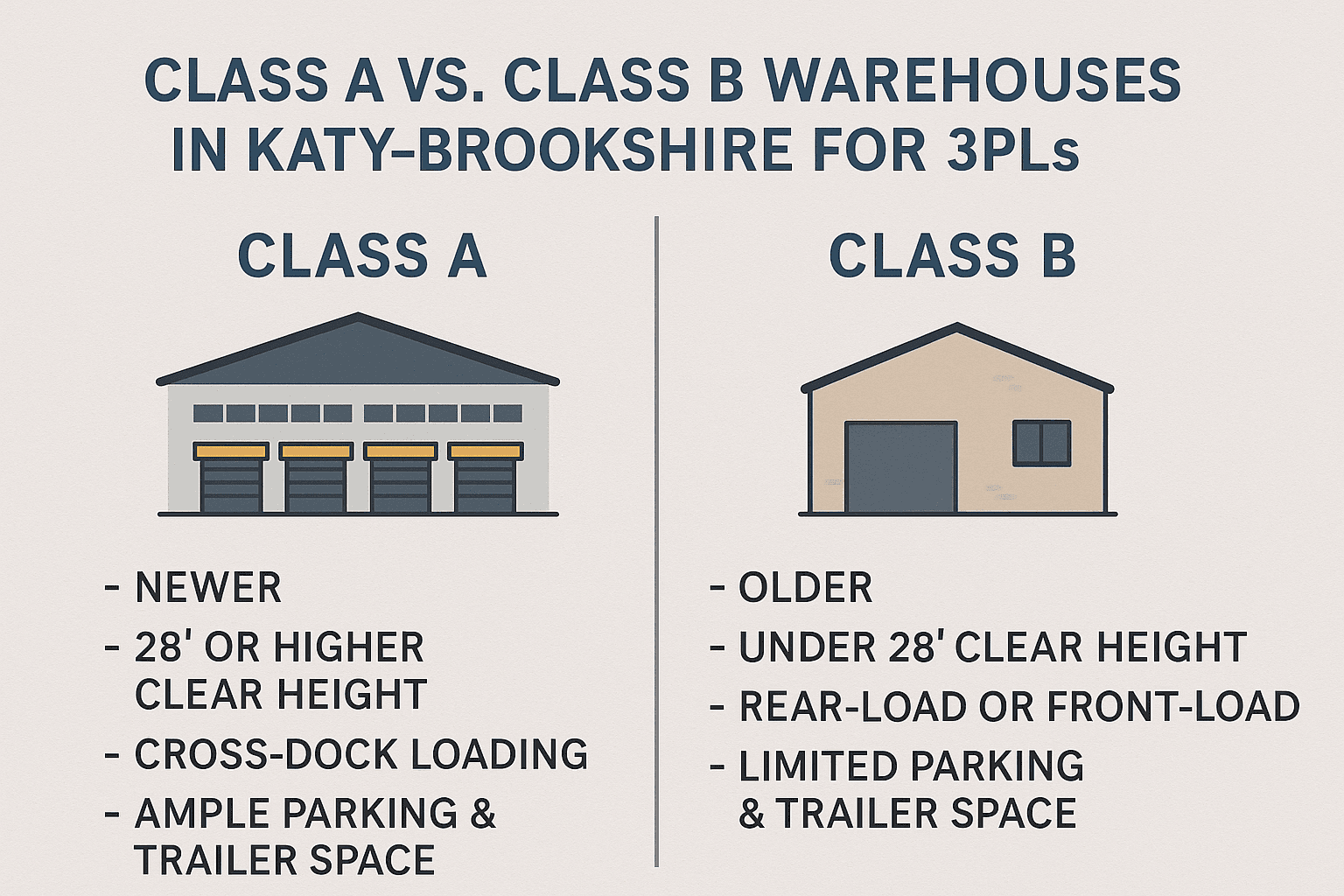
Class A vs Class B Warehouses in Katy-Brookshire: Which 3PL Property Type Delivers Better ROI?
Choosing between Class A and Class B warehouses in Katy-Brookshire? Learn which property type delivers the best ROI for 3PL operations along I-10.
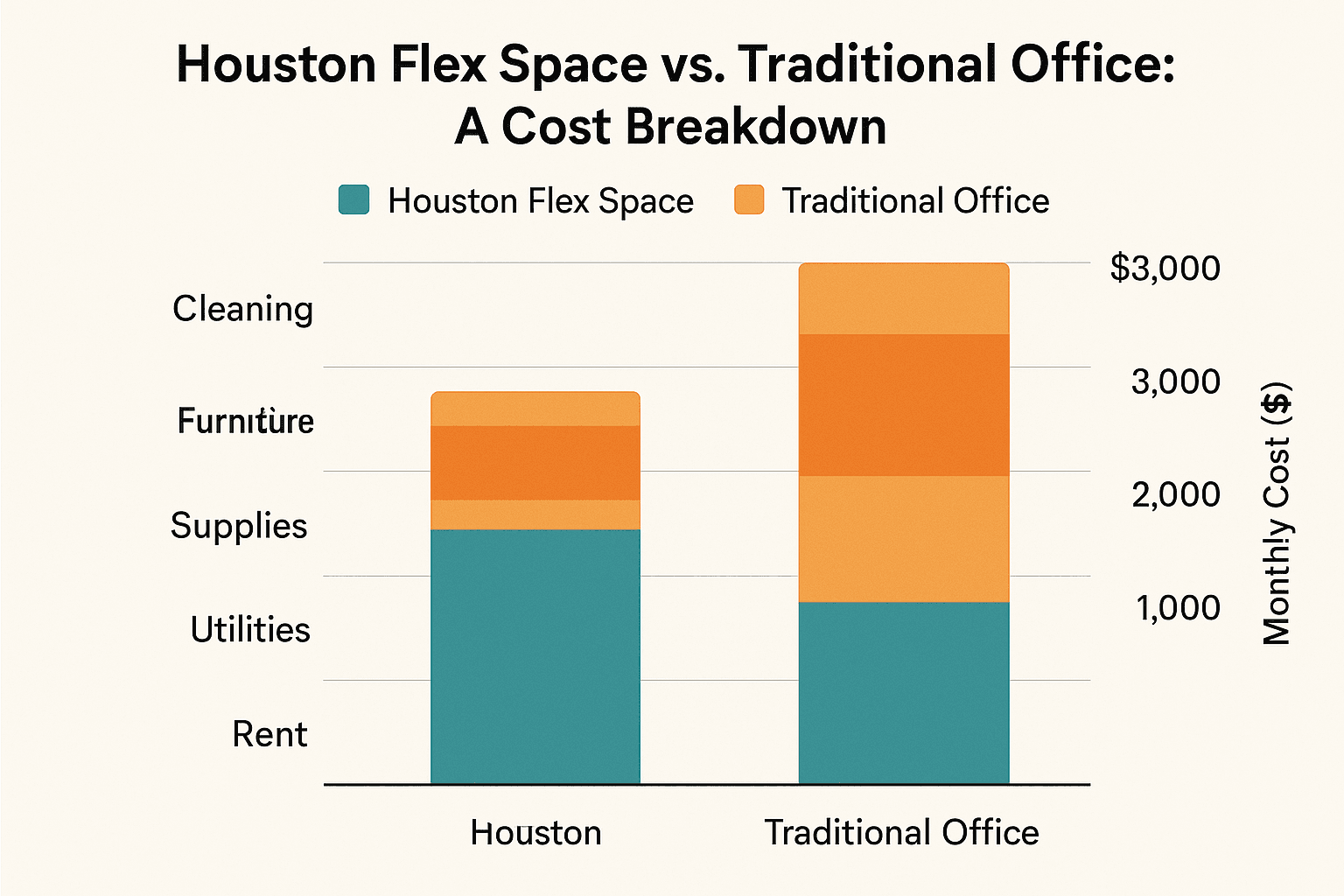
Houston Flex Space vs. Traditional Office: A Cost Breakdown for Small Businesses
Compare Houston flex space and traditional office costs for small businesses. Real pricing data, hidden fees, and market insights from a licensed CRE broker.
How we can help
Talk to a licensed broker about your specific transaction — Houston + New Jersey.